One of the most frustrating situations you face as a marijuana grower is when marijuana seeds don’t germinate. There are several reasons seeds fail to launch—some come from grower error, others from the seed’s genetics, age, storage conditions, breeding protocols, moisture content.
Germination issues are made more complicated because growers use various methods for germinating seeds, but each of the most popular methods has varying but never perfect success rates and risks, depending on factors growers can and can’t control.
What growers almost always automatically believe is they properly attempted to germinate seeds, so germination failures are assumed (without evidence) to be the fault of the seed breeder or seller. Worse yet, in many cases, the seeds are inferior AND the grower is using low-success germination techniques!
Don’t get me wrong—seed germination failure can definitely be the fault of a seed breeder or seller. [Note that sometimes the seed breeder or seller are not the same people, but we use the term “seller” to denote both.]
In fact, the marijuana seeds industry is so corrupt that the vast majority of seeds sold are stale and likely to have germination problems. Read this warning about buying marijuana seeds.
Some sellers store seeds in incorrect humidity and/or temperature that degrade seed viability. Further, they don’t do periodic batch testing of seed inventory to determine germination vigor and strain consistency.
Many marijuana seeds sellers purchase “white label” seeds from wholesale bulk producers and sell them retail, but don’t test seeds when they get them, nor do they do enough or any testing and refreshing of their inventory to ensure a potent batch of seeds every 6-12 months.
Although properly-bred fresh seeds may remain viable for years when stored properly, improperly stored seeds lose vigor within months.
Marijuana seeds’ viability can be damaged during shipping, especially if the shipping is international. Not as much of a problem anymore, but still happening, is that US Customs and Border Enforcement x-rays or otherwise irradiates shipments of agricultural products entering America.
Scientists say it’s unlikely low-dose x-rays significantly damage marijuana seeds–but some government agencies use higher doses that can.
Shipper warehouses, delivery vehicles, mailboxes are not always climate controlled—your marijuana seeds may sit in +100°F temperatures, or humidity way too low or high, before they get to you.
Many sellers are good at putting seeds in hard containers so they aren’t crushed during shipping, but sometimes physical damage to seeds happens before they get to you.
Marijuana seed breeding practices have massive impact on seed viability and germination vigor. Many breeders are careless amateurs who don’t know how to create stable strains that possess intense hybrid vigor.
They make mistakes using chemicals such as colchicine, colloidal silver, or other processes such as inducing hermaphroditic flowers and using hermie pollen, to create “selfed” plants, often trying to make feminized seeds or induce polyploidy, triploids, or other mutations. The vast majority of marijuana seed breeders do NOT know how to make reliably non-hermie marijuana seeds.
Breeding procedures done by amateurs results in defective seeds with low germination rates. But even if such seeds germinate, amateur breeding creates defective seeds that produce plants that exhibit problems with growth rate, phenotype consistency, leaf mutations, low yield and potency, and hermie flowers.
Now imagine a situation in which seeds are connoisseur genetics, 100% fresh and viable—but the grower encounters low germination rate. In this case, germination failure is almost definitely the grower’s fault, but it’s initially difficult to uncover the specific fault because growers use different germination methods, each with its own set of problems.
For example, some people soak paper towels in rainwater, reverse osmosis water, or a 1% hydrogen peroxide/water solution, place seeds so they’re covered towel top and bottom, wait for germination, then transfer germinated seedlings into root zone media or a water culture system.
Other growers soak seeds in a glass of pure water, perhaps with 1% H202, and transplant them when they germinate.
The main failure potential with these processes is they create a risky unnecessary step—transferring a fragile sprouted seed to a different location. It’s much more logical to germinate the seed in the root zone it will grow in, so it doesn’t face transplant shock as soon as it starts its life.
The smarter method of germinating seeds eliminates this transplant shock. By moistening a root shooter, small grow cup containing Pro-Mix, placing seed half inch to inch below surface line, keeping planted seed and its container between 76-81°F using a thermostat-controlled heat mat, you have a higher rate of success…if the seeds are quality-bred and fresh.
Using this method, you don’t handle the fragile seedling; transplanting takes place later to increase root zone size, when the plant is far more resilient.
In our decades of experience, this method works much better than any other. If the seeds are high quality, problems arise only if you use the wrong media, oversoak the media, place seed too low or too shallow, or fail to maintain consistent media moisture and temperature for the 2-5 days it takes a vigorous seed to germinate.
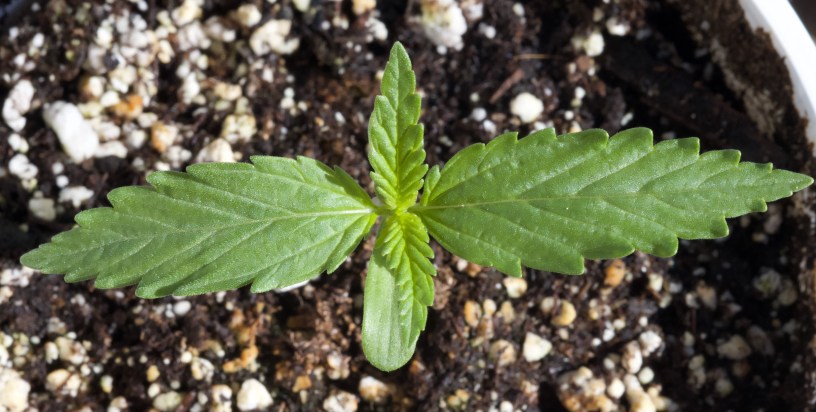
One harsh fact is that even when seeds do germinate properly, growers make mistakes that harm infant seedlings. Seedlings are like clones in that they have very little if any root development, so not much infrastructure for intaking water.
That’s why seedlings do best in a humid environment of 59-65% relative humidity, along with temperatures between 75-79°F for their first week or two. Some seed growers use a humidity dome.
We’ve seen seedlings germinated in desert regions make their appearance above properly-moistened soil, but die within a few hours or days, because humidity was too low and it sucked the life right out of them.
Because seeds cost so much, and you need to count on near 100% germination rate, it’s important to understand the business and practical calculations of seed sellers faced with customer complaints.
First of all, imagine a scenario in which the seller provides 100% fresh, viable seeds with close to 100% germination rate proven via testing.
What’s a seller to do when a grower demands refunds or replacements for hundreds of dollars’ worth of seeds in a case like that?
It’s sad but true: a percentage of growers falsely claim seed failures because they want free seeds.
In other cases, the grower used the wrong methods and materials—the seeds were fine, the grower screwed up. The grower doesn’t want to believe or admit that, or spend more money, so they unethically demand free replacement seeds or a refund.
Marijuana seeds sellers have to make difficult ethical and financially astute decisions in these situations. If a seller automatically sends free seeds or issues a refund to every grower who complains about germination, the seller might soon be out of business!
On the other hand, some sellers refuse to offer sufficient (or any) replacements or refunds. Some also refuse to admit their seeds are defective, even when they know they are.
Their policy is “buyer beware: these are agricultural products, we can’t guarantee you will germinate them properly, we offer no warranty.”
In contrast, the few honorable seed companies evaluate grower complaints on a detailed, case-by-case basis.
They ask the grower what germination method was used, what environmental conditions, media type, and inputs were present during the germination attempt.
They track whether grower customers seem honest and sincere, or have a history of exploiting the seller’s goodwill by unjustifiably and repeatedly seeking refunds or replacement seeds.
They also track grower feedback about each strain, and will stop selling strains that have such a high percentage of reported problems that it can’t all be grower error.
Legitimate marijuana seed sellers whose seeds are viable and fresh are sometimes victimized by haters and shills on social media. I’ve seen threatening emails and social media postings sent to fantastic seed companies threatening to write negative reviews about the company, unless they send free seeds.
We’ve seen many obviously fake 5-star reviews and online grow reports (especially on Reddit) benefiting seed sellers whose seeds and strains are garbage, along with similarly fake 1-star reviews attacking seed sellers whose products are fire.
There’s an entire industry devoted to online propaganda. That’s why you can’t trust much of what you see online.
What works best is when a seed seller and grower have a rapport based on love of cannabis growing and outstanding garden results. The grower and seller should see themselves as “partners” in gardening.
A skilled breeder of connoisseur marijuana strains is proud of their work and eager to see others enjoy their unique genetics.
An ethical grower is grateful the breeder undertakes the risky, complex, costly challenge of creating connoisseur marijuana strains and fresh batches of reliable seeds.
If germination failure happens, both seller and grower would be wise to first exercise introspection, to see if any fault lies within. Both grower and seller can be kind to each other in a spirit of consensus to come up with a resolution acceptable to all.
To make things easier, the following information is worth gold:
- Germinate seeds in controlled conditions from 76-81°F and 58-65% relative humidity.
- Germinate each seed in its own small pot.
- We only recommend growing photoperiod marijuana, so the light cycle should be 18 on, 6 off.
- Using preferred germination media, Pro-Mix HP, moisten the media but do not soak it.
- Germinate two or more strains at same time the same way; compare germination rates. If the strains are sold by different breeders, and one breeder’s seeds consistently fail, but the other breeder’s seeds consistently germinate, you know to avoid that one breeder.
- Do a grow diary, starting with the day and time you placed your seeds into soil, soilless mix, root shooter, or other media or environment.
- Take photos of seeds as soon as you receive them, to document their color, tone, condition before planting.
- Be absolutely certain NOT to overwater initially or ongoing if you’re using solid media such as soil—excessive moisture drowns seeds and helps root zone pathogens ruin them.
- If your seeds haven’t germinated in seven days, they’re likely not viable, and even if they germinate after that, the resultant plants will probably lack vigor and productivity.
- Before you give up on a seed company, ask for free replacement seeds of the exact same strain that failed, and test them after you’ve fully analyzed and perfected your germination protocols. If those seeds also fail, give up on the company.
- If you have germination failures with multiple seeds and strains from multiple companies in the same conditions and a short time frame, it’s likely NOT totally or at all caused by defective seeds. The chances that such a diversity of seeds could all be non-viable are very low. There’s likely something in your technique, materials or environment that’s causing or at least contributing to germination failures.
- You need a professional PPFD meter and grow light. Seedlings are extremely fragile, and excess PPFD will cause many problems, such as stunting. On the other hand, not enough PPFD will cause seedlings to stretch too much. Our experiments show that seedlings do best when we give them 240-275 PPFD as soon as they germinate, for 24-72 hours, then back off to about 220 PPFD or even lower for the next days after that until roots are well established. But realize: there is no one perfect light intensity that works for all seedlings—you have to carefully monitor seedling stalk thickness and vertical growth to ensure just the right amount of light, not too much or too little.

