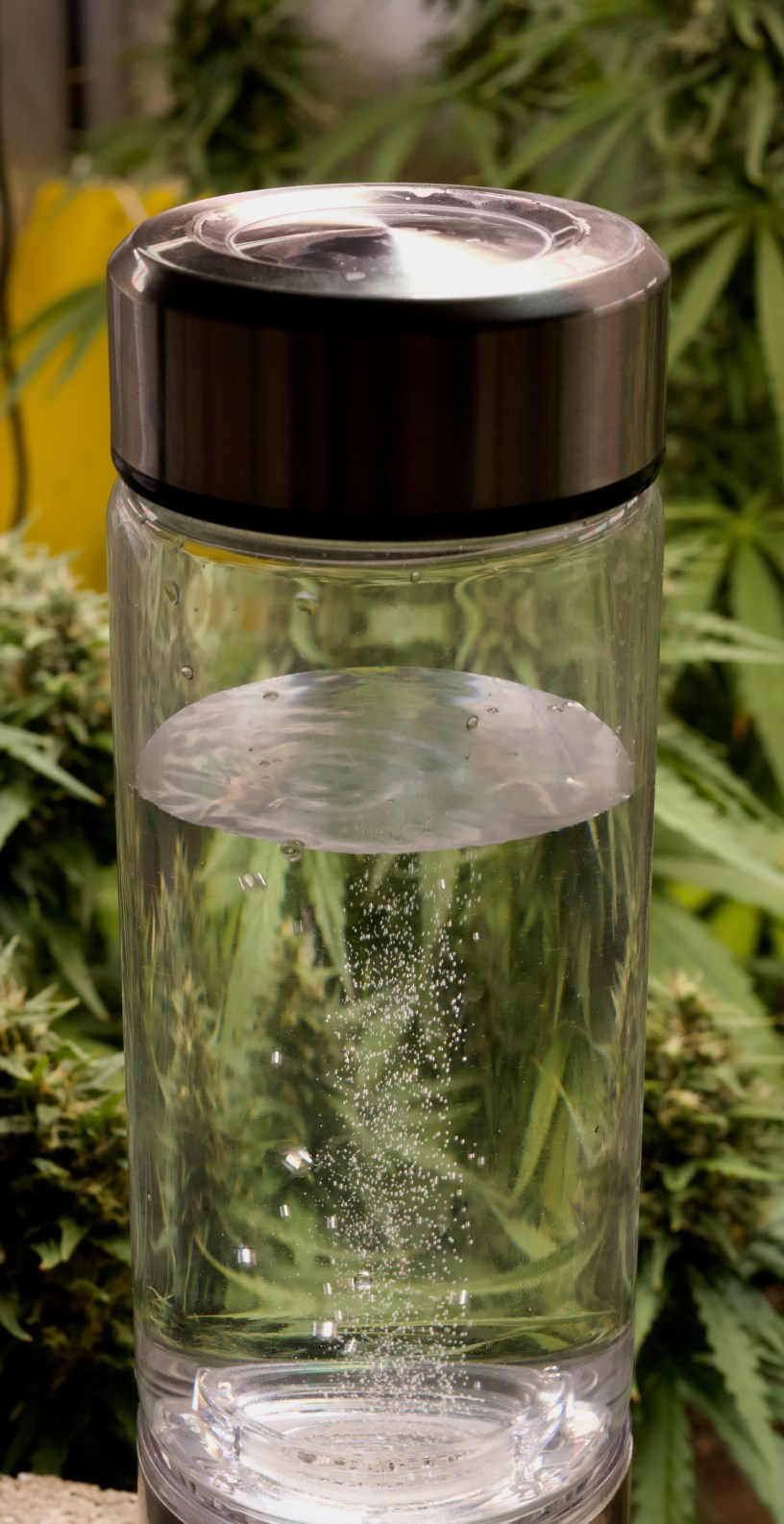
What the hell is hydrogen-rich water, and why should you give it to your marijuana plants, and yourself?
Hydrogen-rich water (HRW) is distilled, reverse osmosis, or rain water infused with extra molecular hydrogen. You can’t taste the difference between original water and water after extra hydrogen is added.
You can personally make HRW by dropping hydrogen tablets into water, or using an inexpensive home hydrogen water maker. In either case use the water as soon as you make it, because after molecular hydrogen is added, it quickly leaves the water and escapes into air.
In an article published in the October 2020 edition of the professional journal Biology of Sport, researchers documented effects of 7-day intake of hydrogen-rich water (HRW) on physical performance of trained and untrained test subjects.
Thirty-seven volunteers participated in the study and were divided into two experimental groups: trained cyclists and untrained subjects. At the end of 7-day intake, performance was assessed by an incremental VO2max test and maximum anaerobic test.
After all subjects ingested HRW daily, only the trained cyclists improved their performance in the anaerobic test with an increase in peak power and overall power, and a decrease in the fatigue index. The ergogenic effect of HRW appears to be correlated to being a trained athlete already. So if you’re already a serious athlete, it’s good to know 7-day intake of HRW is proven to improve anaerobic performance.
In a November 2021 article in professional journal “Experimental Gerontology,” researchers analyzed effects of six months hydrogen-rich water intake on molecular and phenotypic biomarkers of aging in adults aged 70 years and over.
Biomarkers assessed when study started and at 6-month follow up were molecular markers in the blood (DNA and chromosomes, nutrient sensing, protein, and lipid metabolism, oxidative stress and mitochondria, cell senescence, inflammation), brain metabolism, cognitive functioning, physical function and body composition, resting blood pressure, facial skin features, sleep outcomes, and health-related quality of life. There were multiple benefits from six-month HRW intake of only a half-liter per day:
- It extended telomere length and tended to improve DNA methylation; these effects are hard to achieve by other means, and can create extended longevity.
- HRW intake improved physical functioning and improved sleep quality.
- HRW increased brains choline and N-acetylaspartate (NAA) levels in the left frontal grey matter, brain creatine in the right parietal white matter, and brain NAA in the right parietal mesial grey matter. NAA is an amino acid derivative synthesized in mitochondria of your neurons, one of the most concentrated molecules in your central nervous system. It’s a marker of how healthy your brain neurons are, and transports water out of neurons and into extracellular fluid, which serves a neuroprotective function. NAA is thought to supply acetate needed for energy production and formation of cellular myelin sheath. Creatine is an important sports-enhancement and metabolic compound. Boosting brain creatine levels improves memory, processing speed, and mental fatigue resistance—especially during periods of stress, sleep deprivation, and in aging adults.
An article in the journal Nature published July 2020 examined HRW’s effects on oxidative stress and immune functions in healthy adults. In a randomized, double-blind, placebo-controlled study, healthy adults (20–59 years old) consumed either 1.5 L/d of HW or plain water for 4 weeks.
HRW increased serum anti-oxidant levels and significantly reduced apoptosis (cell death) of peripheral blood mononuclear cells. Inflammatory responses were significantly down-regulated in the HRW group.
Perhaps the most interesting study I found on HRW use by humans was published in the International Journal of Molecular Science in December 2025. The article titled “Hydrogen-Rich Water Potentiates Cannabinoid- and Gabapentinoid-Induced Analgesia in Neuropathic Pain” examined whether hydrogen-rich water (HRW) potentiates analgesic effects of substances similar to cannabinoids or the drug gabapentin.
Combined treatments using cannabinoid-mimics and gabapentinoids along with HRW showed increased ability to diminish oxidative stress, inflammation, maladaptive neural changes and nociceptive pathways activated by peripheral nerve injury. HRW is seen as a promising adjuvant to cannabinoid and gabapentinoid therapies, potentially improving efficacy and reducing high-dose drug-related adverse effects.
A study in the journal Frontiers in Neuroscience titled “Role and mechanism of molecular hydrogen in the treatment of Parkinson’s diseases,” published in 2025, found that HRW could be uniquely neuroprotective and neurorestorative for people suffering from Parkinson’s Disease and related neurodegenerative disorders, due to its antioxidant, anti-inflammatory, anti-apoptotic properties.
Other researchers investigated the effects of hydrogen-rich water on neonatal hypoxic–ischemic encephalopathy, revealing HRW has therapeutic effects when neonates consume hydrogen-rich water for 10 consecutive days, starting from 2 days after birth, in addition to conventional treatment.
Furthermore, hydrogen-rich water (HRW) has also been utilized in research on the treatment of depression. Patients consumed 600 mL of HRW daily for 4 weeks, and results indicated HRW enhances central nervous system function by improving mood, alleviating anxiety, regulating autonomic nervous function, improving overall quality of life.
Just recently (beginning in 2023), scientific studies documented a startling new use of hydrogen that is of special interest to marijuana users who inhale combusted or vaporized marijuana, which inevitably damages the respiratory system.
This use is not the same as drinking hydrogen-rich water. Instead, you inhale hydrogen generated by a device. Preliminary studies indicate a diverse range of significant benefits of inhaled oxygen, including lung restoration, and improvements in metabolism and fat-burning, especially in athletes. Take a look here and here for clinical studies related to inhaled oxygen.
We spent a long time looking for an American company selling a device that can make both hydrogen-rich water and also gaseous oxygen for inhalation. The owner of this company appears to be an ethical businessperson importing quality hydrogen generator products such as this.
There’s also an inhaled hydrogen device that almost exactly resembles cannabis vaporizers, and it appears to have clinical proof of efficacy, although we were unable to find independent third-party verification of the company’s product claims.
Now let’s look at how HRW benefits plants! In a 2026 edition of Scientia Horticulturae, researchers reported HRW alleviated drought stress in tomato plants. Much of the research into horticultural HRW is part of “resiliency” studies trying to figure out how to keep agricultural production strong despite increasing global climate warming and drought.
The study found HRW elevated plant antioxidant enzyme activities, reduced malondialdehyde, promoted proline accumulation, thereby maintaining osmotic balance. It up-regulated SlNCED5 and abscisic acid (ABA) biosynthesis genes, activating ABA signaling to reduce stomatal aperture and water loss. Collectively, these findings indicate that HRW enhances tomato drought resistance through a synergistic multi-pathway regulatory network involving “antioxidation–stomatal regulation–gene expression dynamics.”
Ok, so the paragraph is too technical, but it contains valuable information for cannabis growers and human health. For example, HRW reduced malondialdehyde in tomato plants. In humans, malondialdehyde (MDA) is the most widely used biomarker for oxidative stress in the body. Elevated MDA levels in blood, urine, or tissue point to high oxidative stress and are often associated with chronic inflammatory, cardiovascular, and neurological conditions, along with mutations such as cancer. If HRW reduces MDA in plants, is it not logical to think it might do so in us too?
Proline is an amino acid humans synthesize naturally from glutamate—a vital building block for proteins and collagen, playing a critical role in maintaining healthy skin, cartilage, tendons, connective tissues.
Proline aids in cellular signaling, redox homeostasis (preventing oxidative damage), is an energy source during metabolic stress, actively supports the repair of muscle, skin, and connective tissues. It’s logical to assume that if HRW boosts proline in plants, it boosts it in us too.
Of great interest to cannabis growers is that seeds of two tomato varieties germinated in HRW had 40-45% higher germination rate than those germinated in tap water.
And after researchers artificially induced drought stress, they noted that the degree of leaf wilting in the HRW-treated plants was lower than plants not treated with HRW. HRW irrigation significantly delayed drought-induced leaf margin curling.
HRW increased the efficacy of Superoxide Dismutase (SOD), a crucial antioxidant enzyme that acts as a plant’s first line of defense against cellular damage that detoxifies harmful byproducts of photosynthesis and respiration. HRW similarly boosted Peroxidase, an enzyme vital for plant cell wall construction, stress defense, and hormone metabolism.
HRW significantly upregulated the expression of drought-response genes, and assisted plants in maintaining potassium levels and efficacy during drought stress.
HRW irrigation significantly increased carbohydrate contents in the tomatoes harvested from treated plants.
Of great importance is that HRW treatment, while not increasing plant branching, significantly increased fruit quantity per plant, individual fruit weight, and overall harvest weight!
Yet another intriguing study with direct implications for cannabis growers was published in Frontiers in Plant Science in late 2025. The article reports on effects of HRW irrigation at a concentration of 1.0 mg per L on chlorophyll pigments, enzymatic antioxidant activities, and fruit quality in flame grapes.
The results were amazing. HRW irrigation induced significant increase in tissue saturation of carotenoid, chlorophyll a and chlorophyll b. It greatly enhanced photosynthesis mechanisms and performance. Antioxidant enzyme activity, including that of enzymes superoxide dismutase (SOD), peroxidase, and catalase, were also enhanced, reducing reactive oxygen species accumulation and maintaining homeostasis in grape leaves.
Perhaps the most exciting news is that HRW treatment promoted accumulation of secondary metabolites and increased total soluble solids (TSS), soluble sugars, pH, berry weight and overall yield.
The entire reason we grow marijuana is because it produces secondary metabolites such as THCA, other cannabinoids, and terpenoids. One can only pray HRW does for cannabis what this study found it did for grapes!
A December 2023 article in the journal Nature reported that HRW water enhanced seed germination rate, plant vigor and water content, increased plant chlorophyll and protein concentration, and reduced cell death from drought and other stress. HRW-treated seeds exhibited increased Zn and Fe concentrations, and higher amounts of antioxidant enzyme activity in roots and shoots.
Of course you now want to know how to use HRW in cannabis growing. It was easy for me to find a small, portable HRW generator that I use with reverse osmosis water (see photo).
I’ve only been testing HRW use in cannabis for a few months. I use it as a tonic root feed by itself, but sometimes I add beneficial microbes. I don’t adjust pH or add plant nutrients because I’m not sure if that would interfere with the hydrogen benefits.
I’ve also used it as a foliar spray, either alone or with a small amount of liquid magnesium. Again, I do not adjust pH.
Although I can’t say for sure it was the HRW that did it, I noticed that within a day or two of foliar and root feeding small amounts of HRW to two troubled plants, their distress symptoms disappeared.
I’d love to experiment using HRW for total irrigation, even in water culture or other hydroponics, but that seems impractical for two reasons. One reason is I can’t find a home HRW generator that makes more than a few ounces at a time. Making enough to fully irrigate my crops would take forever.
Another reason is even if I could make many gallons of HRW irrigation water all at once, I can’t store it, I have to use it immediately. If I filled a hydro system with it, the water would lose all its hydrogen in an hour or two.
I’m confident HRW benefits plants, because HRW’s chemical mechanisms described in HRW plant research make it almost 100% certain HRW is well worth its low cost as a form of “water supplement.”
When you look at HRW’s benefits in tomatoes and grapes, you see its mode of action easily translates into creating more potent, tastier cannabis buds.
Science still has much to do to figure out exactly how to dose plants with HRW, and I could find no studies showing how to feed HRW to cannabis.
As always if you’re trying a new supplement, grow light or other potentially impactful strategy on your plants, it’s best to use it only on one or two plants, not all, until you have seen the impacts.
That way, if the new variable causes problems, at least it doesn’t ruin all plants in a crop cycle.
The same goes for germinating seeds in HRW. I’d test first by putting lower-value seeds in the usual water you use for germinating, and some in HRW. If you see the germination rates for HRW germination are at least as good if not better than the other water you used, you can be more confident in treating more expensive and/or rare cannabis seeds with HRW.
My initial germination testing shows that using HRW to moisten germination media results in higher germination rate than using reverse osmosis or rainwater.
The studies on tomatoes and other crops lead you to conclude you should give more HRW than usual to plants when they’re experiencing nutrients issues, extreme heat, drought, pests, diseases and other stressors.
I’m sure someone could have fun doing doctoral research and a PhD dissertation titled: “Effects of HRW on Cannabis seed germination, cannabis growth rate, cannabis resilience, cannabis floral weight, potency, etc.”
Someone could probably get rich creating and patenting a home HRW generator that produces large amounts of HRW water at a time, but better yet, I’d love to have an HRW bubbler or electrolysis device that infuses hydroponic reservoir, bucket and other water with hydrogen to provide constant HRW.
One very important fact: HRW is NOT hydrogen peroxide. Hydrogen-rich water (HRW) and hydrogen peroxide (H202) are totally different substances with opposite effects in body and plants.
HRW is a life-promoting liquid for us and plants. In contrast, hydrogen peroxide is a toxic oxidizing agent used to attack living things; it’s an acidic bleaching agent, which you’ll find out the hard way if you ever spill high-concentration H202 on yourself or a granite countertop.
Never confuse hydrogen-rich water for hydrogen peroxide!
On Reddit and other places where amateurs and scammers promote crazy-stupid ideas about growing marijuana, they never provide science. Although HRW may at first sound like yet another obscure hack idea, the science is solid. We recommend getting a professional hydrogen water generator, not the dozens of brands of garbage units on Amazon. This is a legit seller.
It appears that science proves HRW is a very low cost, convenient way to boost cannabis crop performance and your own performance, and I hope you’ll give it a try.

