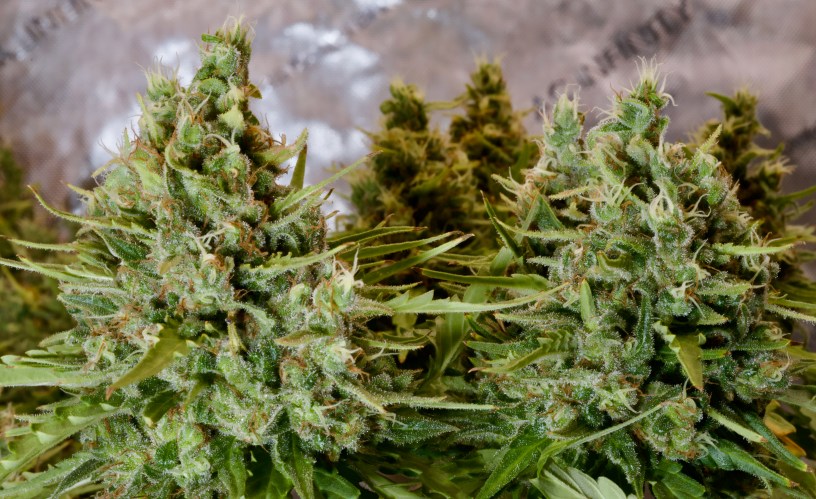
We’ve tested the famous Ace Seeds pure Sativa strain Zamaldelica from several different batches of feminized photoperiod seeds procured over a six year period.
Each test had 100% germination rate, but produced wildly different phenotypes from the same pack of seeds. We usually never recommend a strain with such a challenging array of phenotypes, but two of the most important pheno traits were present in all Zamaldelica plants. These two consistent traits were the bud scent, and the super-psychedelic high.
Looking at short, squat, fat-bud Zamaldelica plants next to ridiculously tall, thin bud Zamaldelica plants, you’d never think they were the same strain. But the unique scent of resinous bloom phase buds and the mind-blowing psychedelic high were exactly the same no matter what the plants looked like, letting us know this strain is stabilized enough to have strain integrity and uniqueness.
Ace Seeds says this strain came from La Reunion Island, off the coast of Madagascar. Marijuana genetics were apparently imported to this island beginning with its earliest colonialist visitations in the 1600s, but the most likely source of cannabis genetics was an influx of slave and immigrant laborers, investors, and settlers from Africa, India, Malagasy, The Netherlands and France starting in the 1800s.
The local name for marijuana is “Zamal,” describing their own landrace Sativa, grown for at least two centuries on this hot, humid volcanic island.
Ace says its original breeding project used Golden Tiger pollen to pollinate a pure Zamal mother. Golden Tiger is yet another legendary Ace pure Sativa, said to be a cross of Koh Chang Thai, Hmong Thai, and two distinct Malawi Sativas.
All Zamaldelica phenotypes are incredibly hard to grow properly. We’ve seen three main phenotypes, but each plant had significant variations:
- One phenotype grows fast, short, produces massive pyramid-shaped buds.
- Another phenotype grows slow, tall, produces low yields of thin buds, ridiculously long bloom phase.
- A third phenotype is moderately tall, buds are columnar but slightly heavier and more rewarding, also has a ridiculously long bloom phase.
Although Ace says Zamaldelica is very resistant to gray mold (botrytis) and moderately resistant to spider mites, all phenotypes of this strain were plagued by gray mold and spider mites when no other strains in the same ideal indoor grow ops were.
The fastest-finishing Zamaldelica had very heavy, dense buds full of mold. Even the thin-bud phenos had mold.
Spider mites love Zamaldelica and even with heavy applications of Azamax and ultraviolet light, we were fighting mites throughout bloom phase on most Zamaldelica plants.
Ace advises you to start directly in 12-12 light if you’re growing from clones, or to only give 2-3 weeks in grow phase if you’re going from seed.
For the fastest-finishing phenotype grown from seed, 2-3 weeks in grow phase was not enough. We could have had much heavier harvests if we’d let the plants go 3-5 weeks in grow phase to give them more structure. Of course, we might also have to grow them outdoors in a desert with less than 30% humidity, to defeat the mold that loves these buds.
Instead, the plants ended up only about 40-43 inches tall. We harvested at day 61 because the gray mold was eating away at the buds, way less than the 11-14 week bloom phase duration stipulated by Ace. The good news is, the few buds we could salvage that were totally free of mold had the classic Zamaldelica taste, scent, and high, even though Ace would say we harvested at least 16 days too early.
In contrast, the other two phenotypes had stretched from 12 inches tall when bloom phase started to as much as 72 inches after bloom phase stretch totally stopped.
Even though we know stress training is bad for plants, the tallest Zamaldelicas were growing into our lights, so we had to put in stakes and gently bend top branches horizontal to reduce height.
One of the biggest problems with pure Sativas is bloom phase takes forever, and in some plants, never fully finishes. When we say “finishes,” we’re talking about buds in which a significant percentage of pistils are orange or brown, at least 25% of resin glands are cloudy or amber, and no revegetation or foxtailing is happening.
With about 65% of our long-season Zamaldelica phenotypes, buds never finished. Resin gland density was low, resin heads small and clear, buds kept foxtailing or growing new small leaves even up to 15 weeks bloom. The one typical end-of-bloom trait that most plants displayed was orange pistils.
The cool thing is that the longer you let Zamaldelica bloom phase go, the more powerfully psychedelic the high becomes.
You don’t grow pure Sativas like Zamaldelica for any other reason than the high they produce. They don’t yield well, not much good for extraction (lacking resin gland density and large gland size), hardly any “bag appeal,” takes a huge investment of grow room time and expense, are too susceptible to pests and diseases, too tall for most indoor grow ops.
And yet, we will grow feminized photoperiod Zamaldelica again and again because the high is similar to a moderate trip on mescaline, shrooms, cocaine, LSD, DMT.
Obviously, it’s not exactly like the high from those substances, but it can feel pretty damned close, especially for novice users.
What kind of high is this? First of all, it’s very strong and “confrontational” for the mind. If you’ve been consuming the usual Indica-Sativa hybrids such as Gelato this and Wedding Cake that, or even so-called Sativas like Haze, this strain will rapidly distinguish itself.
It’s much stronger than strains whose marketers claim 30% THC or more!
The high is a bit of a creeper, then all of a sudden you feel like superman, your brain buzzing as if you’re on cocaine and acid, visuals and aural inputs are glossed like cinema special effects, you have no appetite, you’re full of energy, creativity, euphoria.
Fortunately, except for novices, the high doesn’t create paranoia, panic attacks, or even the kind of alarmed introspection that often comes if you’re in a social situation and super high on Sativa.
It’s a long-lasting, ceiling-less high with significant burnout after 4-5 hours, and we wouldn’t recommend anyone using Zamaldelica all day every day—it’s especially not an evening strain, nor is it a medicinal strain that decreases body pain or inflammation.
The bud smell is like no other strain, so there’s no perfect way to describe it. Some say it has hints of sweet carrots, mango, pepper, roses, sandalwood, lime. Although you can’t easily identify those individual scents, after you’ve grown Zamaldelica a few times, you’ll recognize it always has the same scent and taste, no matter the bizarre divergence of phenotypes you experienced in the grow room.
Unlike most pure Sativas, this strain can handle a moderately aggressive feed program as long as you’re using Pro-Mix HP, quality nutrients, reverse osmosis water, and have at least a seven gallon root zone (ten gallons is better).
A majority of the plants developed potassium deficiency starting in mid-bloom, even though we were using a quality potassium booster.
We run a high-PPFD light intensity, delivering 875-975 at top of canopy, without added C02. To get the plants to finish at all, we gave them 11 hours of light per day in bloom phase. The plants seemed able to handle that, but they’re very susceptible to stress if climate goes out of range, and minor but troubling hermie clusters can develop.
And their leaves start curling and growth slows right away if even a small number of hidden mites are sucking juice out of lower leaves.
Because the short-stature pheno grew so fast and was almost all fat buds, no branch support was needed. Likewise, the buds were so thin on the taller phenos, no branch support was needed to hold the branches up.
We average about 3-5 ounces of dried bud from the largest, tallest plants topped twice as plants went into bloom. For the shorter plants, we can’t estimate yield, because we lost so much bud to gray mold.
Should you grow Zamaldelica? Every skilled grower who loves the Sativa high should grow it at least once. Some people say it grows well outdoors in hot, tropical climates with fertile, well-drained soil where day length is always less than twelve hours. Indoors, it’s a constant battle, but when you experience the soaring, exhilarating, psychedelic high that’s brutally superior to even the best hybrids on the market today, you’ll be glad you grew Zamaldelica.
One other thing: unless you intend to attempt to breed with Zamaldelica (which is a waste of time unless you have a graduate degree in plant science), grow only the feminized photoperiod seeds.
If you intend to breed, get Ace’s “regular” (non-feminized) photoperiod seeds.
You’ll see an autoflower strain and an unusual “autoflower photoperiod” strain marketed by Ace, but that’s not what you want to grow. As you know from reading our article on autoflower, we have zero respect for inserting hempy Ruderalis genetics into photoperiod strains to make autoflower strains.
Check out the lengthy 14-year discussion forum for Zamaldelica here. Grow Ace’s feminized photoperiod Zamaldelica, and be prepared for one of the most challenging grow ops and longest bloom times in your life, but also the cleanest, most complex, head-banging, stimulating high you’ll ever get from marijuana.
One other thing, Ace is one of only two seed companies we recommend. We’ve been sending Ace a list of questions about their amazing menu of rare genetics and their breeding programs for six years. They always assure us they’ll answer the questions, but never do. It would be great marketing for Ace, and fire information for growers, if they would answer the questions. If any of you know the Ace people, please encourage them to answer those questions real soon.

