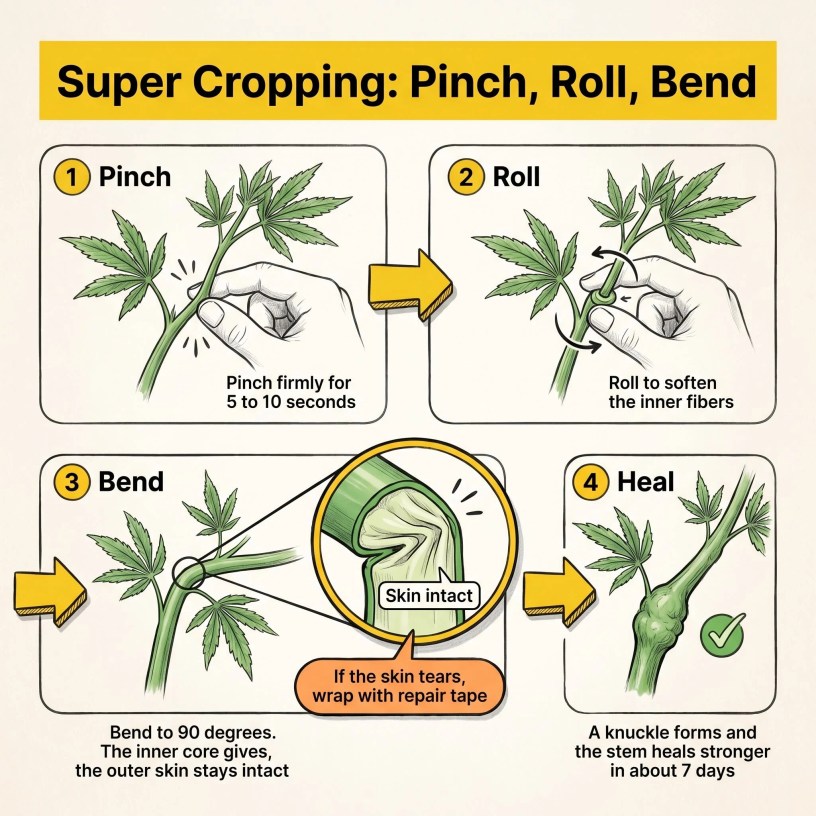
One of the most pernicious marijuana growing fads, mostly promoted on Reddit and other unreliable social media, involves torturing marijuana plants.
Proponents of marijuana torture don’t know the science of what it does to plants, they can’t even agree on terminology. They often use terms such as mainlining, low-stress training, high-stress training, topping, fimming, and supercropping interchangeably and in other ways that indicate they have no idea what they’re talking about.
That’s why we researched the actual science about marijuana plant torture, so now you finally have accurate information.
Why do people do plant torture? These techniques seem to have started because people wanted to have as few plants as possible due to legal and/or logistical restraints (such as a lack of vertical height where they want to grow).
By growing one plant and torturing it so its architecture changes from the normal cannabis main cola vertical growth pattern to a horizontal multiple-branch pattern, the grower hopes to increase harvest weight beyond what a normal unmanipulated plant would produce, create a uniform canopy, limit plant height.
A huge industry of online shills spread these ideas around so they can sell growers clips, nets, screens, and other gear necessary for torturing plants.
The main techniques in this process can generically be called low-stress or high-stress training (LST or HST).
In LST, the grower carefully bends stems and branches and secures them in horizontal position using ties. The grower has to make sure they don’t break branches or stems. The resultant horizontal plant doesn’t have a deep vertical canopy, so the plant gets a more even distribution of light, which might result in heavier harvests.
In contrast, high stress training is more brutal, and definitely damages your plant. HST practices may include cutting off most of the main stalk, deliberately injuring a branch or stalk to (allegedly) create sturdier structure, manifolding/mainlining, in which topmost growth is repeatedly cut off to create huge numbers of branches and colas, lollipopping (cutting all branches and stems off the lower third of a plant), and defoliation/schwazzing (removing almost all leaves, not just fan leaves).
Both these tactics are sometimes paired with SCROG nets to support branches.
As you can imagine, high stress training causes permanent damage to the plant, damage the plant may not ever fully recover from. Not only that, the damaged plant needs a lot longer for its total season, because it requires time to repair damage done by the grower.
This is particularly moronic and ironic for autoflower marijuana growers who claim they grow autoflowers because they’re faster than photoperiod marijuana, but then do plant torture that makes the autoflower season extend way longer than most photoperiod plants ever need, lol.
HST and LST advocates claim without evidence that topping beneficially changes plant hormonal and metabolic systems to supercharge bud growth, weight, and potency.
We looked at dozens of studies exploring how these techniques affect marijuana and other plants, and found no evidence that these techniques significantly improve potency or harvest weight when compared to photoperiod plants merely topped a couple of times and otherwise allowed to grow without torture.
It’s true that some forms of “training” obviously increase the number of colas beyond what would naturally occur, but research indicates the stress and damage caused by training results in more bud biomass, but less potent buds overall, due to severe hormonal and metabolic disruptions.
Science also proves these torture practices weaken plants, making them much more susceptible to pests, diseases, infections. It also promotes development of hermie floral clusters.
When you study the many Reddit posts and other promotions of LST and HST, you see this type of growing is a hobby rather than a professional cultivation approach, similar to Bonsai growing. The time-consuming, painstaking work of torturing plants is a form of therapy for people, a way to pass time and focus on details, kind of like making a living sculpture or building a model airplane.
But it’s not the professional way to grow the heaviest harvests of the most potent buds.
The simple fact is if you procure premium photoperiod genetics and top the apical growth of main stalk and side branches a couple of times a week or two before bloom phase starts, and if your grow op is otherwise professionally dialed in, you’ll get monster marijuana plants, an even canopy, a full tent, and huge yields of sticky buds faster and with much less trouble than with a tortured plant.
Also know without a doubt that autoflower marijuana is inferior to photoperiod, and you can read why here.
These plant torture fads are just a foolish way to complicate marijuana growing. If you want to spend time and money treating your plants like Legos or Gumbies, go ahead, but it’s bad for your plants, unnecessary, costs extra because it extends your growing season unnaturally.
Anyone who has grown professionally knows that topping a quality photoperiod strain on select multiple branches a couple of weeks before bloom phase starts produces monster marijuana plants with huge yields, and you don’t need to do the hard work and spend the money necessary for the bizarre stress training techniques so many people have fallen for.
Keep it simple: you’ll be way more satisfied with your marijuana growing, and your plants will be happier too.
And in case anyone is offended by the truth we told in this article, realize two things: our magazine team is all professional growers who rely on SCIENCE, not online rumors, braindead advice, scams. Here is an excerpt from a REAL SCIENCE article about stressing marijuana plants. Note especially the highlights in bold:
“Despite widespread adoption of the mainlining technique among Cannabis cultivators, scientific validation remains conspicuously limited. Much of the existing guidance derives from anecdotal sources such as blogs and informal online forums, creating a disconnect between empirical practice and standardized agronomic methodologies. Addressing this divide requires a concerted research effort to quantify the morphological, molecular, and biochemical consequences of mainlining across diverse Cannabis genotypes (Da Cunha Leme Filho et al. 2025).
A critical gap lies in the absence of standardized protocols for different Cannabis chemovars—namely, feminized, autoflowering, and photoperiod strains. These genotypes exhibit distinct architectural traits and stress sensitivities, making the development of genotype-specific mainlining guidelines essential. Factorial experiments designed to assess phenotypic plasticity, metabolite output, and recovery time under high-stress conditions would be instrumental in improving reproducibility and scalability (Hesami et al. 2021; Dreger et al. 2023).
Molecular profiling of mainlined plants has yet to capture the stress-induced activation of stem cell niches and hormonal redistribution patterns. Technologies such as transcriptomics, proteomics, and metabolomics are underutilized in characterizing the developmental reprogramming triggered by apical decapitation, despite evidence from meristematic models in Arabidopsis and Populus indicating the feasibility of such analyses (Hu et al. 2025; Satterlee et al. 2020; Miyashima et al. 2013).
Sensor-based automation and artificial intelligence (AI) also remain absent from mainlining research. Precision tools, including RGB imaging, hyperspectral analysis, and real-time stress sensing can be paired with machine learning algorithms to optimize training intervals, monitor plant recovery, and reduce human error (Vishal et al. 2020; Chang et al. 2021; Srivastav et al. 2025). These interventions offer the potential to transform mainlining from a manual craft into a scalable and intelligent horticultural strategy.
Furthermore, autoflowering strains present a unique challenge due to their genetically programmed shift into flowering irrespective of photoperiod. Limited studies have explored whether hormonal manipulation, particularly via auxins or cytokinins, could temporarily override this flowering schedule to enable vegetative extension and response to training. The feasibility of inducing lateral branching in these cultivars without compromising yield quality remains unknown (Bevan et al. 2021; Adhikary et al. 2022).”
So now you’ve seen the science, and the analysis of stress training from our team of long-time professional growers. Here’s a summary of the undeniable truth about stress training:
- Stress training costs a lot of extra money and time in electricity, water, nutrients, SCROG nets, clips, other gear and supplies.
- Stress training may produce more colas, but doesn’t produce higher-potency colas, and in most cases produces less potent colas with more leaves in the buds.
- Stress training autoflower marijuana is particularly unwise, but growing autoflower is unwise regardless.
- Stress training inherently damages plants, making them much more susceptible to pathogens and pests.
- You can fill a tent with an even canopy simply by growing premium feminized photoperiod genetics properly, topping them to create uniform height and multiple colas, and you’ll get heavier harvests of more-potent buds in less time, with less work and expense.
- Stress training is a bizarre fad promoted by amateurs and dishonest marketers online who have no botanical training or scientific data to back up their techniques.
- If you want to do stress training, grow Bonzai trees.

