Every few years, yet another new cannabis cultivation “miracle protocol” is hyped as a revolution in marijuana growing. People promoting these ideas may be well-intentioned, may have had success in their own garden. Unfortunately, their advice doesn’t work well for most growers.
Recall the “schwazzing” cult that advised you to remove all your plants’ large leaves when they first enter bloom phase, and again 20 days into bloom phase. Proponents claimed without scientific evidence that this process increases bud development and potency.
It doesn’t. Instead, it stresses plants severely so they develop hermie flowers, growth slows, harvest weight and potency decreases, plants are more susceptible to pest and diseases, and total bloom phase is extended (creating extra gardening costs).
Then there was the practice of keeping plants in total darkness for the final 2-4 days of bloom phase, or running only far-red lights during that time. Proponents claim this increases THC by as much as 30%, without increasing CBD or other cannabinoids. Again, no science to back up their claims; testing shows this harms plants, decreasing harvest value.
There was also the “flushing” fad, in which growers deprive plants of all nutrition during final week or two of bloom phase, when proper nutrition would have kept plants healthier and more productive. Proponents claimed flushing “purges nutrients salts and other contaminants out of buds, making them tastier, easier to combust, safer.” Never saw proof of that.
The newest “radical cultivation method” is called no-veg growing. This method involves growing photoperiod cannabis without the usual 4-6 week veg (grow) phase before flowering. Instead, plants are started in bloom phase light duration (12 hours per day).
No-veg proponents claim buds grown in the no-veg method are tighter, have better calyx to leaf ratio, are more potent than regular growing produces.
The no-veg method has apparent advantages. The fewer weeks you’re growing your plants, the less light, nutrients, water you have to feed them. You’re not spending as much time and money growing the lower part of the plant below budding branches, so you create less disposable biomass.
If you’re growing non-feminized photoperiod seeds in no-veg, you see males and hermies within a couple of weeks (instead of weeks into bloom phase), and remove those plants, leaving only desired females.
Also, a typical long grow phase adds weeks to your plant life, and during those “extra” weeks, your plants are susceptible to pests and diseases.
When you give clones or seedlings an early start on 12-hour light regimen that immediately triggers them into flowering, they produce floral structures as they’re producing overall plant infrastructure. Instead of the 12-16 weeks needed for a typical full season, no-veg plants might be ready for harvest after 8-12 weeks, or even less.
Another benefit of the no-veg method is you start your plants in the terminal container they’ll grow in their entire life, rather than in smaller containers that roots overgrow, requiring transplanting.
No-veg advocates claim the short height of no-veg plants allows increased light penetration, resulting in more “top-shelf” buds. Their claim is based on an assertion that buds on full-size marijuana plants are most potent at the top of the plant, because that’s where maximal light intensity is delivered, with buds below the top of the plant less potent because they get less light.
These claims aren’t supported by any published peer-reviewed photobiology research specific to the no-veg method. Indeed, latest cannabis lighting studies indicate blooming cannabis plants getting 650-950 PPFD delivered at top of the canopy and via side lighting by professional LED lights in gardens (without added carbon dioxide) absorb maximal light energy, using it for photosynthesis that drives all metabolic and productive functions throughout the plant, including creation of cannabinoids, terpenoids, and floral structure.
The latest science reveals lack of light penetration in full-size plants doesn’t automatically create inferior buds compared to no-veg plants. Instead, light spectrum and intensity at the top of the canopy is the key to plant performance.
The harsh thing is, a substantial majority of grow light manufacturers don’t have photobiologists or use latest scientific research on cannabis photobiology when designing their chip arrays and spectral output. Instead of worrying about light penetration, growers should be much more concerned that their grow light spectrum isn’t ideal for promoting cannabis growth, harvest weight, and potency.
It’s interesting that some long-time growers have been doing an inadvertent form of no-veg growing for decades, though we didn’t really want to. It happens with outdoor cannabis growing in geographic locations where springtime and summer day lengths are 11.5 to 14.5 hours max.
We germinate seeds outdoors as early as possible after frost danger had decreased. The plants never achieve a typical vegetative (also known as “grow”) phase, but instead develop unevenly-distributed pre-flowers within a week or two, especially if they germinated when natural day length was less than 12.5 hours.
Most plant structural development in these situations consists of what growers call “bloom phase stretch.” As branches lengthen and main stalk elongates, buds develop and fill in. But a departure from that morphological development happens when plants get confused by lengthening days prior to summer solstice, causing them to reduce or eliminate floral development. After the solstice, days shorten again, and plants are re-triggered back into flowering.
In an ironic way, autoflowering marijuana is similar to a no-veg approach. Autoflowering cannabis has a 2-3 week grow phase, then automatically starts flowering. Of course, the big difference is that photoperiod no-veg plants get 12 hours of light per day almost their entire lives, but autoflower plants need at least 18 hours per day start to finish. In fact, autoflowering strains grown indoors usually require MORE total electricity hours than photoperiod strains.
As of yet, the scanty research papers provided by no-veg proponents do not prove their claims are accurate. Indeed, their claims seem to be based on flawed beliefs about the interaction of leaves, light, and photosynthesis. Let me explain…
The main advocates for no-veg growing are a consortium of horticultural businesses looking to profit off the no-veg approach. Their primary marketing claim is that no-veg growing results in more harvest weight per year and a better return on cultivation infrastructure/materials costs.
But here’s the most important fact: these alleged benefits only accrue if you’re a high-density commercial grower. That’s because no-veg plants are short and squat, averaging only 1-3.5 feet in height, lacking the branching and stalk strength to produce impressive bud weight per plant. You have to grow a lot of plants all at once in a very dense, crowded array, and you have to grow year-round so you have enough crop cycles to make up for the tiny yield per plant (compared to yields from topped/trained full-size photoperiod plants).
To succeed at no-veg growing, you also must use a high-tech, intensive-input approach in the first two weeks of plant life, or the experiment is a waste of time.
This means a perfect irrigation and feeding schedule, expensive inert root zone media like rockwool (or a water culture system), professional grow lights and photosynthetic photon flux delivery/monitoring, flawless temperature/humidity/vapor pressure deficit, an experimental approach to watering frequency and volume, and an absolutely sterile growing environment with zero chance of pest or pathogen.
No-veg advocates admit there’s no room for error in their protocol, especially if you grow from clones instead of seedlings. In regular cannabis growing, plants have time to recover from problems. In no-veg, they don’t. If something goes wrong at any point in the cycle, but especially in the first two weeks, results will be unsatisfactory.
Because no-veg proponents are embedded in the Big Ag sector of the hydroponics industry, their clients are usually commercial farms that have the money, personnel, and expertise to run sea of green industrial-scale indoor grow ops. Most home growers of connoisseur cannabis will never have or want that kind of infrastructural capability.
Some growers use autoflower cannabis as a no-veg approach, even outdoors where autoflower plants won’t get anywhere near the 18-20 hours of intense light per day they need for maximum production. Autoflower plants that receive less than about 15 hours of intense direct light per day perform poorly.
Growers look for photoperiod cannabis strains that possess mostly equatorial genetics, because strains with substantial pure Sativa influence may do well started in short day length situations, due to their lineage being acclimated to an area of the planet where day and night length are almost equal.
One caveat: you often have to reduce light hours per day to 10.5 to 11.5 to force pure Sativa to build substantial buds, copious resin glands, and finish flowering within a reasonable amount of time.
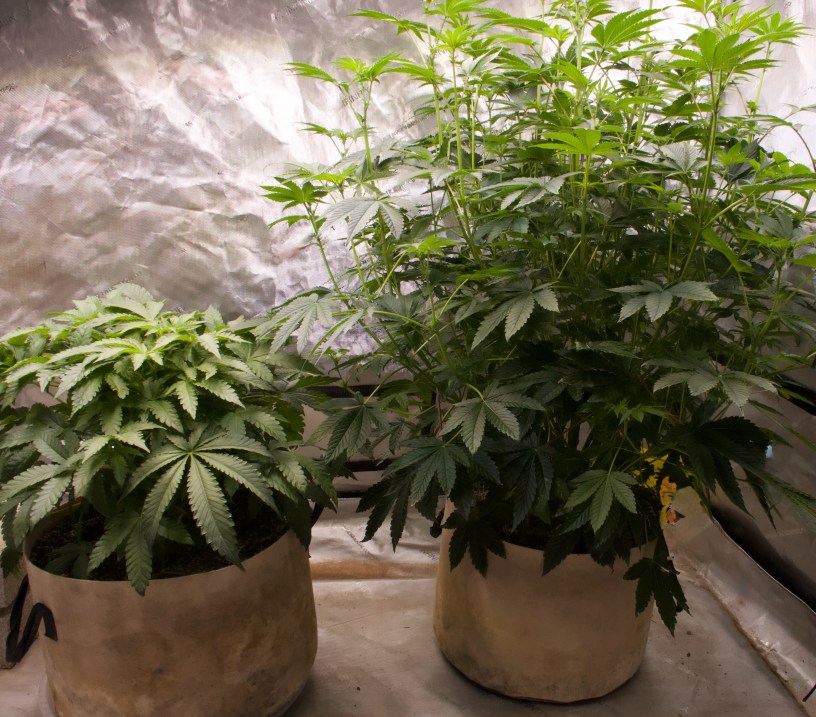
Is the no-veg method worth using? The photo accompanying this article shows why not. Both plants are the same strain, started the same time. One was no-veg, the other was 30 days in veg. The no-veg yielded less than an ounce. The plant grown with normal veg phase yielded a little more than three ounces, and the buds were stickier. Do the math.

