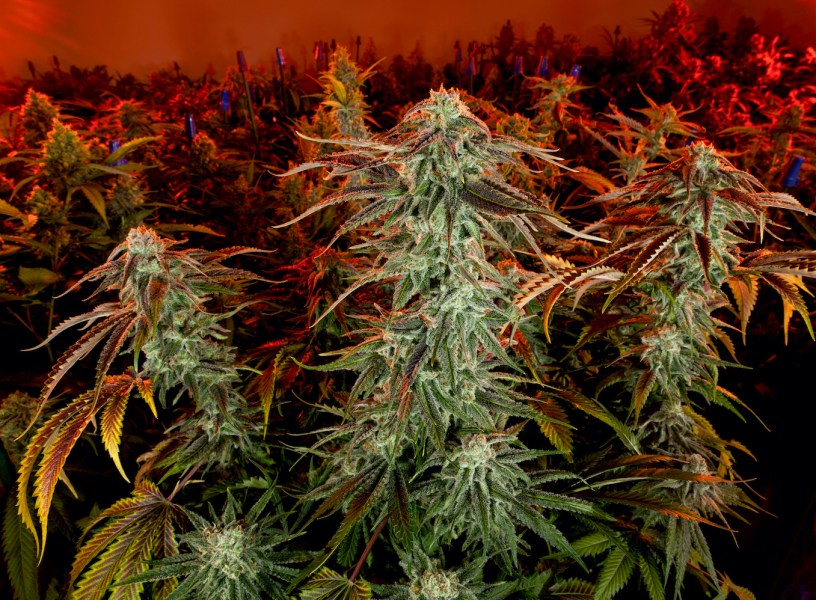
Marijuana bloom phase is payoff time for your entire season, and today we’re sharing bloom phase hacks that increase harvest weight, potency, grow op efficiency, and your cannabis-using pleasure.
One thing we always emphasize, you get way more buds, potency, and versatility when you grow feminized photoperiod marijuana instead of autoflower. Read more here about that.
The first hack has to do with how you transition your plants from grow phase to bloom phase. Many growers do sudden shifts in lighting and nutrients during this transition, and this causes plant stress that leads to problems with growth rate, vigor, flowering, and potency.
Growers of photoperiod cannabis plants often abruptly shift their light cycle from 18 hours to 12 hours per day when their plants are ready for bloom phase. This shocks plants, and can lead to hermies, slow growth, other problems.
A better method is to first set a target start date for the 12-hour bloom phase light cycle. Then, beginning a week or two before target date, reduce your lights-on hours by 30-45 minutes per day until you get to 12 hours on, 12 hours off.
Marijuana Bloom Phase Nutrients Hacks
The grow-to-bloom transitional period is a time when many growers make big mistakes with their feed program by shifting lights to bloom phase 12 on/12 off and immediately starting to use bloom phase nutrients.
A better method is to choose a bloom phase start date target, and have the last 1-2 feedings before bloom phase starts be a 50-50 combination of grow phase and bloom phase base nutrients.
You may have heard of a bloom phase hack involving adding sugars into the root zone. Most hydroponics companies sell a sugary product for marijuana bloom phase plants, but we’ve found that blackstrap unsulphured molasses works better and is far less expensive. If you add beneficial microbes to the root zone, molasses feeds them. We add 1/4 teaspoon molasses per gallon of nutrients water every other watering during bloom phase.
Molasses contains iron and magnesium along with sugars.
Speaking of nutrients, fertilizer companies constantly hype “bloom booster” products heavy in phosphorus and potassium that are alleged to create faster bloom phase onset, more budding sites, and a faster bloom phase.
We’ve never seen evidence these products actually work; some contain plant growth regulators and other substances that may harm plants and people.
These early bloom phase products pollute the root zone with too much phosphorus and potassium, especially if you use other P-K bloom boosters later on. This often leads to nutrients lockout and other problems.
If you’re in a big hurry to get bloom phase going, reduce your lights-on to eleven and a half hours instead of twelve during the first two weeks of bloom phase.
If you’re growing pure or near-pure Sativa, sometimes you have to do that to force your plants into flowering.
After the third week in bloom phase when your plants are definitely fully triggered into flowering, gradually increase the lights-on time a few minutes per day until you’re at 12 hours.
Another marijuana bloom phase hack is to ensure that your lights-off grow room temperature during bloom phase is at least 3-5 degrees below lights-on temperature.
Some strain families such as Kush and Afghani that come from places with very cold nighttime temperatures do much better with this regimen, and it’s generally useful for all types of cannabis except equatorial Sativa strains.
One other tip: use tiny amounts of extracts of kelp, alfalfa, bone meal during bloom phase. The way we do it is to buy powdered versions, put a small amount in reverse osmosis water, brew a few days like brewing a compost tea, then mix the extract water in with our regular hydroponics feed program, which is manufactured by TPS nutrients. You can get those powders in high qualty form, from Espoma.
Incremental Marijuana Harvesting
One of the most important bloom phase hacks is called incremental marijuana harvesting.
Most growers wait until resin glands are going cloudy and many are falling apart, and/or the breeder’s recommended bloom phase duration, and then harvest all at once.
Incremental harvesting gives you more versatility than that. To do it, first set a target date for harvesting as the upward end of the breeder’s duration estimate.
For example, I repeatedly grew a strain that the breeder said needs 7-8 weeks in bloom phase, but it was more like 8-10 weeks when I actually tested the strain.
On one occasion, I was forced to harvest almost three weeks earlier than I normally would for this strain, when its resin glands were still firmly erect, bulbous, and crystal clear.
Most growers correctly wait until about 35% of resin glands are cloudy, amber, and/or falling apart before harvesting, but I didn’t have that option.
I feared that early harvesting would cost me maximal harvest weight and potency. However, the high from that early harvest was like psychedelic caffeine, almost all THC, with little or no CBD, CBN, and other compounds that tend to limit THC’s effects.
The high was wonderfully energizing, great for exercise, and much less sedating than the high from buds I’d harvested later in bloom phase.
The next time I grew the strain I harvested some buds three weeks before the long-duration harvest date, two weeks before, one week before, on the target date, and one week after the target date.
Each set of buds had its own taste, scent and high. The earliest harvested were the most stimulating and caffeine-ish, and that harvest timing is now the timing I use every time I grow the strain.
The last-harvested buds produced a small amount of euphoric head high, but had an overwhelming body high perfect for getting rid of pain, insomnia and similar complaints. It was almost like cannabis Quaalude.
Sampling buds in an intelligent, aware way reveals how incremental marijuana harvesting uncovers the ripening and production of cannabinoids and terpenoids during bloom phase.
Instead of looking at the breeder’s seed catalogue, seeing that the strain is listed as ready for harvest after 56 days in bloom phase, for example, and harvesting at 56 days, harvest earlier and/or later than that recommendation, sampling the buds to see which high suits you best.
When I grow highly-sedating Kush and Indica strains for customers, I personally dislike the heavy, sedating high of those strains.
So I harvest buds for myself about two weeks early and get a more stimulating high, while allowing most buds to continue ripening to create the knockout Kush and Indica punch my customers crave.
This works in the other direction too. I’ve grown Sativa strains, sampled them at the recommended harvest time, and found them so stimulating that they made me anxious, paranoid, or sleepless.
By allowing these zingy Sativa buds to ripen past recommended harvest time, some THC degrades to CBN, and more CBD develops, creating a less-jarring, more chill high.
Doing incremental harvesting, you find the effects you love the most, and that set of buds is used to determine bloom phase duration the next time you grow that strain under the same conditions.
Incremental harvesting doesn’t significantly decrease your total harvest weight or total resin gland weight. Indeed, incremental harvesting of top buds may actually increase total harvest weight because it allows lower buds to grow bigger than they normally would, in part due to increased light penetration.
And of course, never forget the traditional bloom phase hack of adding carbon dioxide (C02) to your grow room air to create ambient levels of 900-1100 parts per million during lights-on phase.
Added C02 stimulates photosynthesis and plant metabolism to give you bigger, more resinous buds faster. It also allows you to run your room a little hotter than usual.
We conclude this article with a warning: you hear a lot of people talking about “amazing” marijuana bloom phase hacks such as plunging their plants into total darkness for the last two days before harvest, interrupting the night cycle with far red or other wavelengths, using so-called bud hardeners and bud sweeteners, withholding water, and other tactics.
We’ve tried these bizarre actions…and they all suck. None of them are backed by legit, third-party scientific research done on cannabis plants.
In fact, one traditional, popular bloom phase hack called “flushing,” (feeding your plants only reverse osmosis water and perhaps a flushing formula for the last 7-10 days of bloom phase), has been proven to be harmful. All hydroponics flushing does is starve your plants of necessary nutrients at a time when continued nutrients feeding will stoke more bud weight and resin development. The claim that unflushed hydroponics buds are polluted and taste bad compared to flushed buds or “organic” buds is bogus.
The marijuana bloom phase hacks we’ve given you have been tested in numerous grow ops with a variety of cannabis strains. Experiment with them while paying close attention to your plants, as every grow room, season, and strain is different, but in most cases, these hacks give you faster growth, bigger yields, more potent buds.

