Editor’s Note: We have two articles on our magazine about the very important topic of vapor pressure deficit.
As climate change happens, more growers find they need to ADD humidity to their grow op rather than remove it, to ensure plants grow well.
When we wrote those articles, we’d tested ALL the professional humidifiers sold to the marijuana growing industry, and many sold on Amazon and elsewhere that are just generic low-cost humidifiers.
All of them sucked. The biggest problem for all of them, including one sold by Hawthorne/Scott’s Miracle-Gro via their front Ideal-Air, is they don’t have reliable humidistats. Most of them have many other problems as well, making them virtually useless.
The good news is we recently found a humidifier that was definitely engineered for growers. It’s made by AC Infinity, a Los Angeles electronics company that a couple of years ago got very serious about entering the marijuana growing gear space.
I’m testing their Cloudforge T7 15 liter humidifier and it’s everything you could want.
They created a humidity pencil probe on a long wire that you can place anywhere in your grow op to get the most accurate local humidity reading.
This probe reads humidity accurate at +- 1-2% RH, which is incredibly precise.
The unit display and controls are super easy to understand use, and AC Infinity engineered the unit so the display can be turned off to prevent light leaks during dark cycle.
The mist settings are very diverse and useful. One thing I absolutely love is that the mist is dispensed throw a directional flexible tube assembly so you put the humidity just where you want it.
I’ve only tested the unit for a few days of constant operation so far and there are no glitches. It’s flawless and plant growth rate has soared because now I am dialing in my VPD precisely.
The Cloudforge also interfaces well with apps and external controllers, and AC Infinity appears to be focusing its engineering and creativity on making useful marijuana growing products in general.
You can buy the unit direct from AC Infinity but I recommend finding a local dealer who has it and buying from them instead, to cut down on shipping time and to ensure customer support if you have a defect. AC Infinity is NOT so good at customer service and shipping.
This is the ONLY humidifier on the planet that works well for marijuana growing, and you need one to maintain ideal VPD so your plants have maximal performance. Take a look at the following video, and the one at the end of the article, which are third-party reviews of the Cloudforge humidifier.
Now, on to the older VPD article that has useful information too…
We already did an article about vapor pressure deficit (VPD) a while back–you should read it because it totally explains all the technical details of what vapor pressure deficit is.
In today’s article, however, our goal is to emphasize that vapor pressure deficit is an increasing problem for indoor and outdoor marijuana growing, and one that’s very hard to fix.
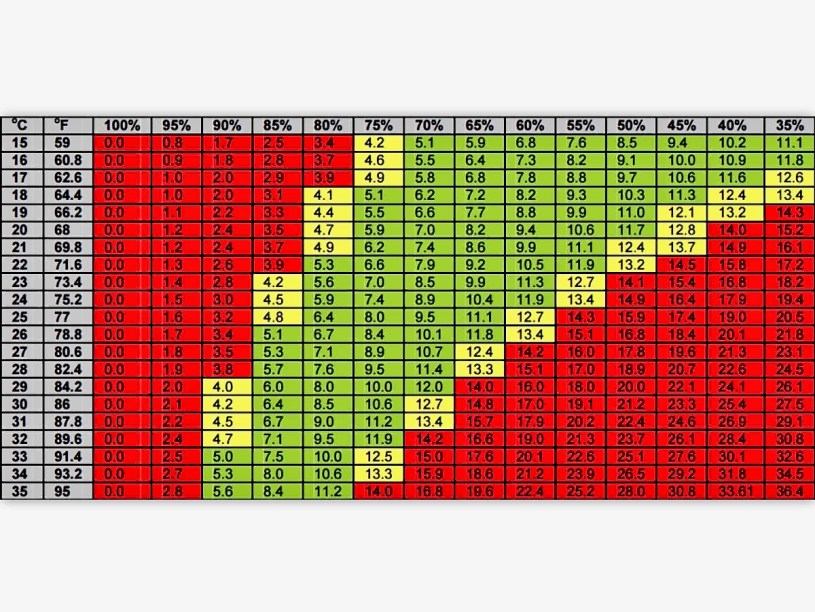
To make it as simple as possible, look at the chart at the top of this article. Here’s a stark fact: if your marijuana growing space’s temperature and relative humidity aren’t within parameters shown in the chart’s green zone, and also in the range of temperature that marijuana plants like, your plant performance significantly decreases.
Deficits in growth rate, physical development, nutrients and moisture utilization, bud maturation, bud potency, and overall metabolism happen every second your marijuana garden is out of the green range.
Vapor pressure deficit problems delay crop maturation, foul up feeding and watering, create leaf issues that lead to pests, molds, and mildews, and cost you money and time. In some cases, they’re fatal to plants.
As climate change heats the planet, vapor pressure deficit problems increase whether you grow indoors or outdoors.
Climate change creates more evaporation, leading to increased humidity, accompanied by hotter temperatures.
When you look at the VPD chart and start applying it to your cannabis growing situation, you see the huge challenges.
For example, grow rooms lit by LEDs and/or with added carbon dioxide (C02) should operate at 78-84°F. To avoid vapor pressure deficit problems, relative humidity at those temperatures must be kept in a very narrow range, over 60-65% and under 85%.
But humidity that high creates growth conditions for botrytis (gray mold), which flourishes in dense buds when humidity is above 50-55%. You see from the VPD chart that temperatures that work coincide with humidity below 50-55% are too cold for growing marijuana.
Adding humidity to grow room air isn’t as anywhere near easy as removing it. Sure, using a Quest professional dehumidifier, you can easily remove excess humidity.
Unfortunately, we’ve tested 17 humidifiers, including so-called professional models that cost as much as $700, and none work well or at all.Their main problems are inaccurate humidistats, hard to clean/fill/drain, leaks, insufficient mist volume, faulty engineering and workmanship, insufficient warranty and tech support.
Another issue is that many of us remove air from our grow room by using exhaust fans, which removes the humidity you’re trying to add.
Ancillary issues include the fact that many hygrometers that measure humidity are woefully inaccurate and unreliable, whether they be mechanical or digital. The same goes for most humidity controllers and climate controllers used for automated triggering and shut-off of fans, dehumidifiers, humidifiers, and other gear.
Part of the problem is humidity isn’t uniform throughout a grow room. Levels in the plant canopy may be quite different than levels where your humidistat and hygrometers are.
For growers in the American West (especially deserts) but also increasingly in other parts of America, humidity is often ridiculously low.
We heard from a Florida cannabis grower whose only humidity problems used to be there was way too much of it. But this year (2023) so far, climate change drought has made Florida’s humidity as low as a desert, which plagues marijuana growers indoors and outdoors.
At the same time that air is super dry, temperatures are very high, so air conditioning is used more. Problem is, air conditioning dries out air.
We’ve tried all kinds of hoped-for fixes so we could have a grow room at the right temperature and relative humidity for ideal VPD. These include leaving open vats of water in the grow op, trying to have the lights on when the humidity outdoors is highest and sucking that air into the grow room, using a mist system and/or foliar spraying.
The mist system and foliar spraying are somewhat effective, but messy, hard to manage, water-wasting, and can damage leaves.
The best fix we’ve come up with is labor intensive. Using humidifiers that have automatic-off function and a digitally-set humidistat, we monitor grow rooms every hour, sometimes manually turning on and off the humidifiers and adjusting their mist amount and flow rate. It’s a hassle, but it works better than relying on faulty humidistats and humidifier controls—we’ve never tested a humidifier that was reliable enough to automatically, always achieve pre-set target humidity.
The most important thing for you to know is that maintaining ideal VPD helps ensure optimum marijuana plant growth, but for every second your lights are on when VPD is out of range, your plants stop growing and experience stress.
This lowers harvest weight and potency, extends crop times, makes plants susceptible to insects and pathogens, and in extreme cases, kills plants.
In outdoor settings and greenhouses, mist systems and foliar are more practical than in indoor grow ops, and can also be used to deliver nutrients and protectants (such as potassium silicate).
The other thing to know is that if vapor pressure deficit is caused by too-low humidity, growers have to carefully monitor root zone moisture and nutrients feeding.
That’s because low humidity air sucks water directly out of root zones, leading to excess nutrients salts, at the same time plants are trying to intake more water. This can cause overfeeding and root zone toxicity.
I’m sorry that I can’t give you a total fix for the VPD problem. Marijuana plants prefer a narrow temperature range of 74-84°F, but it’s the relative humidity accompanying that temperature that determines VPD compliance and plant performance.
The good news is that in situations when plants had stopped growing because VPD was out of range, as soon as we restored correct VPD, the plants started vigorously growing.
We’ve seen situations that defy logic and science, such as when Lethal Paul, played by Javier Bardem in No County for Old Men, and who runs New420Guy Seeds, grew large plants outdoors in bone-dry, Venus-hot Nevada in summer.
Paul’s outdoor marijuana garden was so far out of VPD range we were surprised his plants grew at all, and more surprised they successfully matured to produce gooey, huge outdoor marijuana buds.
If you want to get rich as an inventor, create and patent an affordable, reliable grow room and greenhouse humidifier with a reliable humidistat so growers can set target humidity and be sure the device will maintain it. Many marijuana growers need a reliable humidifier, but can’t find one. If you make one that works well, you will have plenty of buyers.
If you want the fastest growth, highest potency, and heaviest harvests from your plants, do whatever it takes to ensure your marijuana garden temperature and humidity are in the green zone on this article’s VPD chart.
 Growing Marijuana Perfectly!