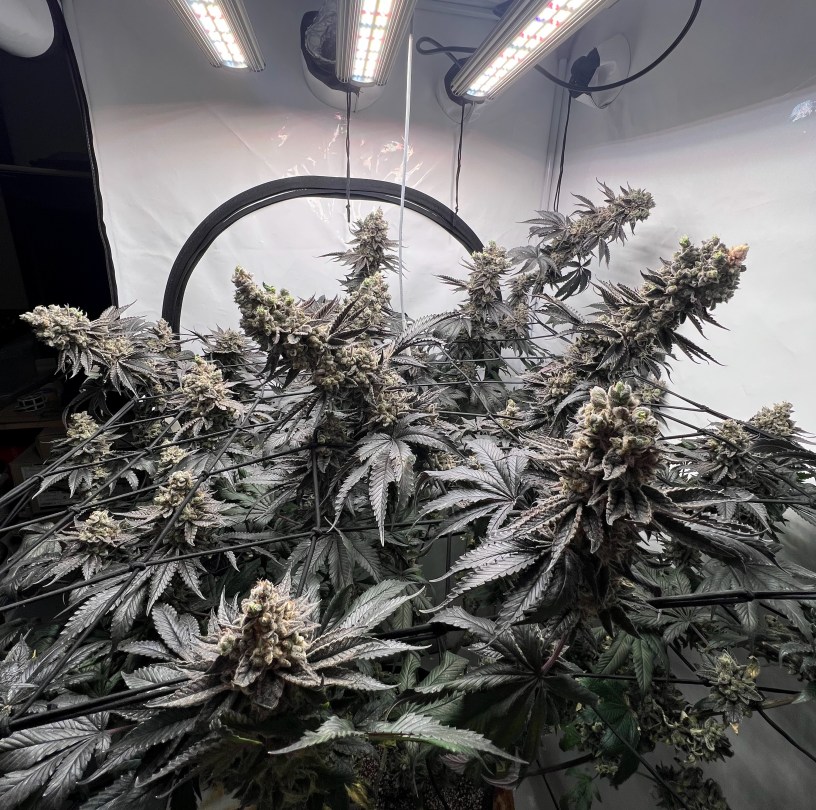
This article is a preview (rather than a cultivation report) of Dutch Passion’s Ice Cream Haze (Crockett’s Haze x Ice Cream Cake) feminized photoperiod strain.
We usually never write about a strain until we’ve grown it at least once, but we’ve gotten totally accurate strain info from Dutch Passion before, and this strain is so popular worldwide that we figured it’s safe to highlight it.
We’re getting seeds, and will deliver a strain report in a few months.
A serious report on any Haze strain has to include Haze’s hazy history. Cannabis connoisseur growers over age 60 remember Australian marijuana seeds and strains pioneer Neville Schoenmakers releasing the pioneering Neville’s Haze in the early 1980s.
Neville became a victim of international police action because he was the first person ever to operate a major, international marijuana seeds mail order service. He’s said to have died in 2019, although mysterious sources claim he is still alive somewhere in the Australian outback, growing monster marijuana plants using desert sand and hydroponics.
Neville’s Haze was about a quarter Northern Lights, which is a 100% Indica heritage strain The rest of his Haze was almost pure tropical Sativa. Neville inserted Indica genetics into his Haze to tame its Sativa height, ludicrously long bloom phase, and to increase bud size, resin gland density, and harvest weight. It worked.
But where did those tropical Haze genetics come from? Here’s a verbatim cut and paste of what we’ve verified is at least a partially accurate (and fascinating) insider biography of the earlies Haze:
The True Origin of Haze Marijuana
Author: Big Herb
It all began in 1969, In Santa Cruz, California. At the time, there was Thai Oaxacan and Punto rojo or Colombian red point – some of the best landrace imports in the area, and some of the best smoke around. It was also at this time a local surfer boy named G, was enjoying his youth as many others during that era of freedom. Not particularly the cannabis lover, G. did not have the passion that most of us have for the sacred plant. Despite this, G saw an opportunity to make a quick buck while having a free smoke and some fun. In 1969, the riverside SoCal surfer backcrossed his Punto rojo bag seed in what might be the luckiest” accident. This accident would go on to become most famous cannabis strain of all time. The pollen chuck created a very large amount of seed which was used for the duration of its existence.
During the next year the seeds produced the four varieties. I was given a description by Sam of “fruity“, “sour` `root beer“,“cola“,“chocolate“ and “hashy“. Later, a more accurate description of each variety was given. The first being Magenta, which those in the inner-circle knew as the “Root beer pheno“, and the rest of the world knew as “purple Haze“. Then, there was the “Gold“ which was known to carry musky sandalwood and pine traits. In actuality it smelt like cat piss late in flower, and before a cure. “Blue“ and “silver“ were of the Spicy Sweet peppery type, and silver was considered strongest- all of them had a deep rich lingering after-taste. The four varieties of original Haze (magenta, gold, silver, and blue) were never stable, and each year had slight variations. The leaf pattern was always the same, and the colors were not cold induced. The calyxes only showed color as the leaf were always bright green. An indicator of true Haze lineage is the appearance of a red sap when you cut a true Haze plant. This indicator particularly showed itself in the purple pheno. The best plants were always volunteers from the previous year’s seed droppings.
The effect is what stood in memories of those lucky enough to experience this gem. Compared to be “acid-like“, it had a euphoric feeling which was very clear. This feeling was accompanied by extreme happiness and periods of laughter, while having no ceiling effect. What made the plant so special was the long period in which she stood in ground. The special plant stood in the ground for around nine months which cannot even compare to the eight to ten week indoor varieties of today. The long duration of the growth gave the plant the time to develop its complex flavors, aromas, and most of all, its effects. The harvest time is what’s known as harvest moon and takes place around December-many months of paranoia. In those days, the knowledge wasn’t as abundant or available as it is with today’s technological advances. The ripening of the trichomes wasn’t an indicator of when to harvest. Rather, pure instinct and a watchful eye coupled with patience were used for harvest. The plants weren’t selectively cut down after a nerve racking, and painstaking nine months. It was at this point in time that the entire crop was chopped down.
There is in existence, a famous yet quite rare “Original Haze Poster- The Cosmic Boogie -1976.” The poster explains in detail the soil recipe used, and both the germination and harvest times. This gorgeous master piece is credited to R.L. who was a partner of G, and one of the main growers for few years. Along with R.L., his girlfriend, and a graphic street artist, the poster was collaborative effort. A group effort, it was R.L’s idea, and his lovely girlfriend’s creative writing, along with the help from friends and the artist’s skillful work. The poster was sold at a local supply store, and was kept hidden under the counter. In order to obtain the item, you had to be in the know. Can you dig it.
G, the creator and main grower had a partner named R.L. for a few seasons. R.L. lived nearby and had his own greenhouse. G and R.L. grew upward of 150 pounds of Haze each year. The pair never went by the name the Haze brothers. The Haze seed was highly protected and the grows were under tight control. Few were lucky enough to be part of the growing efforts. There were actually several players involved, but again they were all closely guarded. Many wanted in on the Haze grows, but access was strictly-off limits. R.C was one of them. Better known as Robert Clarke, R.C. was from the Cruz and was attending college at the time, practicing his craft- experimenting like a mad scientist, and working his way toward a bachelors and master’s degree. R.C. followed his passion, and has made many contributions to our community since then with his books and articles.
Another young man who lived in the Cruz , now known as Sam the Skunkman, went on to become a prolific figure in the cannabis movement and industry. The man’s contributions are immeasurable and his passion has shaped the cannabis evolution today. The effects of his contributions can especially be seen in what is considered today to be the cannabis Mecca Holland.
When Sam and R.C. came to Holland in 1984, the standard changed for high quality bud in Holland- a traditionally hash smoking country. Along with many of California’s praised genetics, he introduced Europe to Haze.
During the seventies, three brothers from New Jersey, two of whom were attending college in the Cruz , started to bring large amounts of the Haze back east during a series of trips. The three brothers let’s call Joey Bobby and Petey. All three brothers were great writers and cannabis connoisseurs who were the ones to coin the name “Haze brothers“. While no one else called them that name, the Santa Cruz team had created more creative names for the brothers. The eldest brother, J whom I spoke with recently has been quite busy and furthermore successful is doing quite well. Throughout the years, J followed his passion went on to become a great writer and still lives in the Cruz. Back then, J was cut out of the circle for breaking the cardinal rule which was the kiss of death. The brothers were strictly consumers that brokered large amounts of Haze back east. They knew nothing about growing it, but they were very familiar with smoking it. During the late 1970’s, most of the Haze on the east coast, particularly the tri-state area, came from the brothers.
The Haze seed was never sold, and remained highly protected for good reason. With the wide spread distribution of the Haze, at its height of operation hundreds of pounds were produced. It is no wonder that others tried to create their own legend or tale of discovery, and so we see Haze traits in various hybrids. So, the idea of Haze seed landing in hands of many far and wide is highly probable as there was occasionally a seed found. There is no question that over the course of years, beans got spread. Others outside the circle smoked the Haze and likely grew out of the seeds that were found here and there. So, there is the blue dream Haze hybrid from Cali along with NYC Hazes and many others which are not spoken of or shared. The Haze survives in many hybrids all along the both coast, then you have the Dutch offerings which we have Sam to thank for.
The year 1976 was a very eventful year: crops were enormous. The year brought extraordinary Haze flowers- many so huge branches broke because of the weight. This was the year the historic Haze poster was released, and it was also at time that G and R.L had a fallout that ended their partnership. For a short time after, R.L did his own grow locally, then went to Mexico. Rumor has it that he went to grow large scale for a syndicate. G hasn’t spoken to R.L since the split, and it is thought he might be deceased.
The Haze survives today in several known hybrids- once again thanks to Sam. The taste and the aromas can be recognized by some of the old timers who were privileged enough to have experienced the Haze from Santa Cruz. As for the effects, that is another story. Now, Sam the Skunk Man has without doubt brought original Haze stock to Holland, but in exactly what form, pure or hybrid, is unknown. G said that he did not give Sam’s Haze stock, but acknowledges he did live on the block and did some trimming. Therefore there is the possibility he collected seed working with, or smoking the varieties. Personally I believe that the latter was more probable. Sam had relations with R.L., and he had much of the same seed stock that G worked with. Remember, R.L. did his own thing for a while, and it’s very likely Sam got plenty of seeds from him. This is quite clear by many post of Sam that reference his Haze genetics from 1976.
Thanks to Sam’s preservation, the Haze survived in several forms from a number of different companies. The reported Haze stock which was once, and probably still is pure can be found from the flying Dutchmen, Seedsman and Tom hill. The most prestigious hybrids come from MNS- Mr. Nice seedbank from Haze stock obtained by Nevil Schoenmakers in 1985, from Sam. Then there is Cultivator’s choice selections of Haze hybrids made from Sam’s- some of which are still available. In 1981, just as the accident came about, it all ended. After about a 10 year run, the Haze failed to produce. The buds were too thin and wispy for commercial production. It started as an accident, a pollen chuck, and since G was not a breeder, he never stabilized or backcrossed the plant. As a result of this the plant soon died out .The search was on for something new. Sam returned to the Cruz and sold G a large amount of Skunk seed which was easier to grow, and which happily filled the void.
Always remember that the Original Haze started with the surfer boy G then expanded with R.L. G and R.L never referred to themselves as the Haze Brothers- that title goes to the three brothers from New Jersey who are responsible for introducing much of the east coast to the magic from Santa Cruz. The title original Haze thought of by G, is derived from Jimi Hendrix purple Haze song. Sam is responsible for spreading Haze stock by bringing it to Holland. It is because of his preservation, determination, and dedication and love of this sacred plant that the younger generations, such as myself, still have the opportunity to have a taste of the most magical strain of all time.
For Haze heads, I’d like to say G is doing well, but his memories are fading. Haze seeds are still held by G, and I’m sure some others. While there hasn’t been any success with germination, as of recent, several attempts and methods have been applied and anything is possible. Keep in mind the same way the accident started it can happen again. So let’s get cracking.
Much love, respect, and thanks to everyone mentioned. Credit goes to DJ of Santa Cruz who has been patient and kind enough to share his experiences as well as G’s with me. This is compiled from my many hours of Haze homework, extremely deep passion to know every detail and my relentless pursuit of the truth. This story I was told is the true origin of Haze.”
Dutch Passion’s Ice Cream Haze is Ice Cream Cake (a rare Indica-dominant hybrid) crossed with Crockett’s Haze (CH). CH is a mostly Sativa strain. Its genetic origins as listed by Crockett Family Farms are a little murky: they say it’s a “secret Michoacán Sativa” crossed with a rare Mexican Sativa. The secret Sativa is allegedly the Haze component.
Dutch Passion is the only major cannabis seeds company posting detailed genetic, breeding, and cultivation advice for their strains. They’re also the only marijuana seeds company to publish authentic grow diaries with photos, along with third-party cannabinoid and terpenoid test results. The growers writing the diaries aren’t paid shills—they’re serious home growers just like you and me. Because we haven’t grown ICH yet, we now summarize what other growers and Dutch Passion have said about growing the strain, as follows, starting with the fact that all reviews are overwhelmingly positive…
One grower reported starting four feminized photoperiod ICH seeds indoors in soil; three germinated, and the grower chose two plants to go forward with. The plants needed 9-10 weeks in bloom phase, and were super-cropped to create multiple branches. The plants yielded seven dried ounces from two plants; buds were easy to trim. Grower reports very aromatic buds. Most importantly, the grower reported two phenotypes:
“One was more Sativa and Haze dominant. The other was more Ice Cream Cake dominant – making her more compact and frostier with purple coloration. Both phenotypes are very terpy & sticky with impressive potency, around 25% THC has been independently measured. The Haze-dominant lady can be a little hungrier and fussier, while the more hybrid-style plant is very easy to grow and just a little quicker in flowering.”
Another grower germinated seeds with a 100% germination rate. The plants grew very large, which the grower attributed to Sativa genetics.
“There are very interesting, fruity Haze phenotypes to be found,” the grower wrote. “The Haze part is dominant and that is shown in about 50% of the plants. The other half is a mix of Haze with the uniquely delicious doughy, creamy & pungent Ice Cream Cake taste. The most intensely ice-cream tasting buds are slightly more compact with a completely different terpene profile, which clearly show the influence of both genetic lines. Ice Cream Haze is a top-class feminized cannabis seed variety. She was easy and vigorous to grow and delivered top quality buds.”
Other feedback on ICH stipulate as much as 25% THC, bloom time of 8-10 weeks, producing potent Haze buds with spice, fruit, cake scents. The high is strong and euphoric, but not aggravating. Skilled indoor growers see yields averaging 4-5 ounces per plant. Outdoors, the strain can grow very tall, needs trellis support, and produces massive yields.
This detailed ICH review is very useful:
“This was my personal run of Ice Cream Haze (Dutch Passion) in a 70×70×160 cm indoor tent under a Mars Hydro FC‑E3000 300 W LED. I grew it from seed, trained hard, and paid attention every week — this isn’t some spray‑and-forget project. The Strain Ice Cream Haze is a hybrid between a classic Haze and Ice Cream Cake (Gelato × Wedding Cake). It leans sativa, but the Cake/Gelato genetics give it structure, terpene richness, and density. The Haze mother comes from Crockett’s Haze, which makes it vigorous, tropical-fruity, and very sticky. Growing It Germination: June 16, paper‑towel method → planted in 1 L. Vegetative Stage: Weeks 1–5, she stretched aggressively. By week 3, I moved her into a 15 L pot and started LST, topping, and main‑lining. The plant loves to grow fast and tall, classic Sativa architecture, but with a Cake-ish bud structure that makes training manageable. Flowering: Around week 8 I switched to 12/12. The stretch was heavy early in flower, but manageable with training. Dense buds formed quickly, sticky resin coating everything. Finish: Wrapped around day 100–110. Terpene profile was insane — tropical fruit from the Haze, creamy undertones from the Cake, and a sweet, sticky aroma that hits immediately when you break a bud. This strain is potent, no question. A few puffs and you’re drifting — not struggling to finish a joint, but savoring it. I smoke pure joints, and even with three or four hits I don’t feel the need to burn the whole thing immediately. This is not “get shit done” weed. It’s “reward myself” weed. Best for: Evening, gaming sessions where I just want to explore, reading, writing, reflecting. Also perfect before a full body massage — it melts tension but doesn’t knock me out. Avoid when: I need to be laser-focused in work or personal life. Trying to be productive? Not with this. Onset & Effects: Fast uptake, very euphoric, keeps me vibrant enough to think and act, but not too sharpened. More floating than driving. Munchies: Real deal. The fridge disappears. Cheese, bread, snacks — all of it. Ice Cream Haze is one of my favorite grows and smokes. It’s tall, sticky, flavorful, and powerful — but not reckless. The growth behavior is very Sativa-dominant: vigorous, fast, with huge potential yield if you control the plant early with proper training. The buds are dense, sticky, tropical-fruity, and creamy from the Cake side. If you know how to train a sativa, you’ll get massive yields and an insane terp profile. If you’re more about relaxing than racing, this is reward weed.”
You might wonder why Haze marijuana has been so popular for so long. It’s because an authentic Haze high is like psychedelic caffeine with enough Indica component to avoid causing paranoia and the shakes. Haze often has a turpentine-pine scent when it’s been bred back to its origins. Properly-bred and grown Haze is one of the strongest of the almost-pure Sativas commercially available, providing a stimulating high that somehow also calms you down.
Dutch Passion is one of few reliable marijuana seeds companies. We highly recommend you get Ice Cream Haze feminized photoperiod seeds, and see for yourself why they’re the only Dutch marijuana seeds company still worth buying from.
 Growing Marijuana Perfectly!