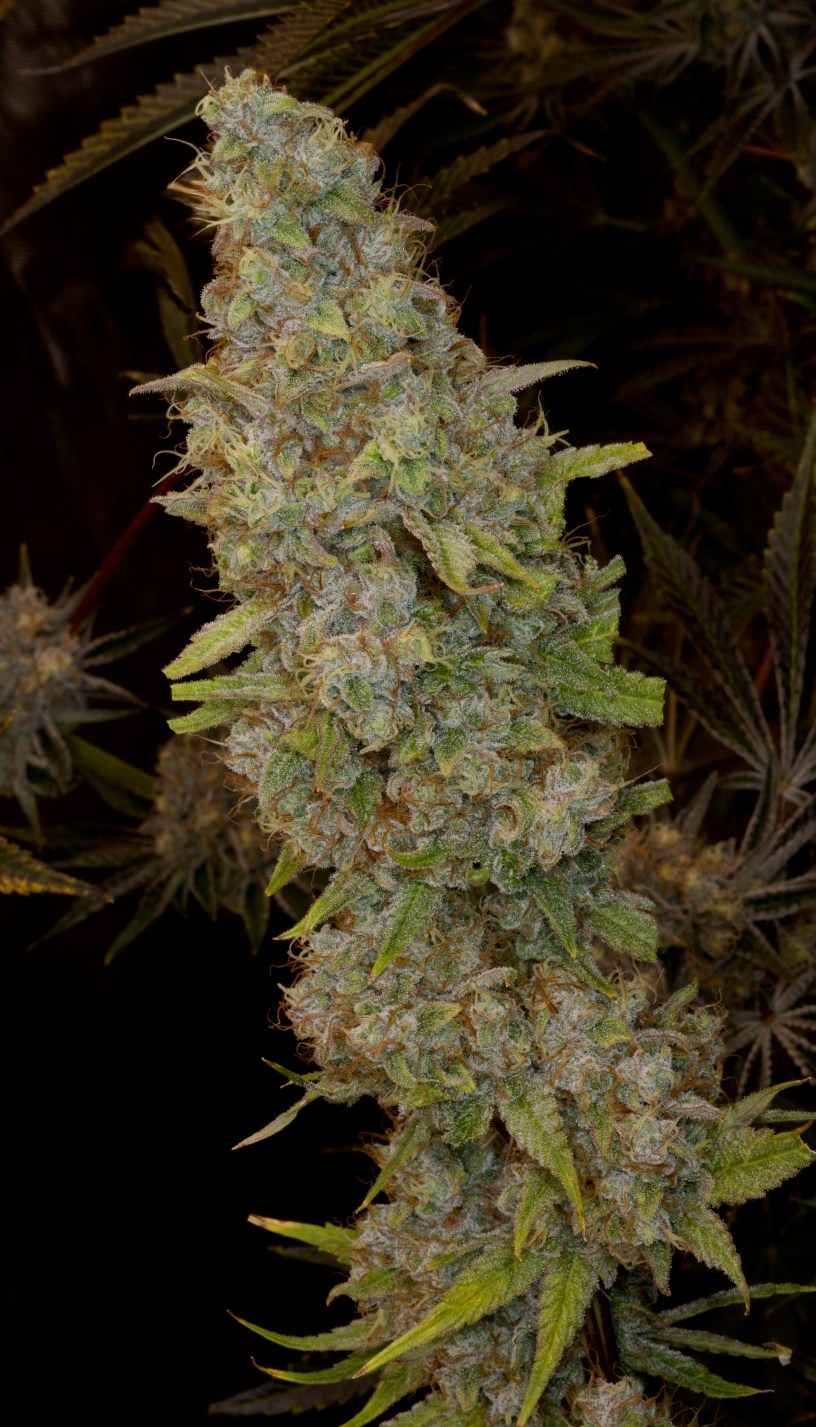
Humboldt Seed Company (HSC) just released several new strains for 2026, but we’re still testing their stellar new strains from 2025! Today’s cultivation report is for their feminized Banana OG photoperiod strain, released in 2025.
Genetic Lineage
HSC reports the strain was created from a rare cutting succession preserved in Northern California’s famous cannabis growing region, the Emerald Triangle, for decades. The breeding genetics are listed as various versions of Banana OG, a strain described elsewhere as a cross between Banana and Ghost OG.
Ghost OG traces directly back to original cannabis pioneers who traveled the world in the 1960s and 70s procuring landrace cannabis seeds and developing them into the foundation for today’s marijuana genetics diversity.
In the Hindu Kush mountains of northeastern Afghanistan all those years ago, marijuana explorers found local people cultivating cannabis unlike anything else in the world—landrace Afghani cultivars well-adapted to the harsh, cold, dry, high-altitude, desert conditions.
True Afghani plants are short, extremely vigorous, with massive leaves, branches, stalks, deep green in color. In bloom phase, plants develop extremely thick buds, filled-in internodes, and dense resin formation with fat, cloudy and amber resin glands. The classic Afghan “skunk” smell, along with terpenoid scents of pine, sandalwood, and pepper, infuses buds and glands.
Local growers told these early cannabis seeds tourists that their plants are mainly grown for processing into sieved Afghan hashish, and charas (a soft, hand-rubbed resin gland goo). That’s why Dutch and North American cannabis entrepreneurs call these unique cultivars “hash plants,” and crossed them with Haze and other tropical Sativa strains.
There are vague reports of other Banana marijuana strains, including one created in California’s Santa Cruz highland area, called Chiquita Banana or C. Banana, described as mostly Sativa, with scents and tastes of lemon, other citrus, pepper, and banana, very high THC percentages, and a 9-week bloom phase.
The so-called Banana Haze is described as almost pure Sativa, made by crossing Silver Haze with Banana OG.
Sadly, we find no legit source for stable, phenotype-consistent, professionally-bred, heritage, high-THC Banana cultivar marijuana seed strains other than what Humboldt Seed Company first provided in 2025 with its two banana strains, Banana OG and Banana Melt.
One important note for cultivators: OG strains come from a place without molds and mildews, so OG strains tend to be susceptible to gray mold and powdery mildew. Astute breeding, such as done by HSC, has significantly reduced this risk, but these Kush buds are very thick, so pathogens may be something you have to battle with. When you’ve seen the solid yield and fiery high of this strain, you know any cultivation challenges can be overcome, and it’s well worth it.
Cultivation Test Conditions
- Indoor grow room using SANlight LEDs.
- Five feminized photoperiod Banana OG seeds germinated in Pro-Mix HP. 100% germination rate. Pro-Mix HP used throughout the test grow.
- Vapor pressure deficit & grow room temperature within ideal range + – 7%.
- Competed in a grow op with two other strains for use as comparison.
- 18 hours light in grow phase; 12 hours light in bloom phase.
- Treated with high-intensity ultraviolet light at end of each light cycle, starting mid-bloom phase.
- No added carbon dioxide.
Nutrients & Feed Program
We exclusively use TPS Nutrients Ultra Bloom and Ultra Grow one-part bases, along with their additives Organic Cal-Mag OAC, Silica, Root Booster, Nitrogen-primer, Signal, Canopy Boost.
This exclusive use of only TPS is based on professional, competitive testing of TPS versus Athena, Advanced Nutrients, GH, Canna, Humboldts (sic) Secret, Remo, Fox Farm, House & Garden, Emerald Triangle, and others. TPS not only performs better, their cost per crop is lower, their feed charts are superb, products are very easy to use, their customer service is honest.
TPS doesn’t have a feed chart specifically for using TPS supplements with its one-part bases, but does have useful feed charts for its one-part bases.
Based on how plants react to the nutrients load, we use 40-60% of the recommended dose of supplements, based on bottle dosage and TPS feed charts. We highly recommend you contact TPS to ask about specific dosages of their products.
We also add Mykos WP and Versa beneficial root zone microbes: Mykos WP is used from week two grow through harvest; Versa is used week two bloom through harvest.
Note that Kush varieties are notoriously hard to feed properly, often developing nutrients-related leaf and health issues by mid-bloom, especially if you’re not using reverse osmosis water and ensuring proper pH. We recommend slightly underdosing the plants, and doing a pure reverse osmosis or rainwater flush every two weeks instead of a feeding, starting in mid-bloom.
Especially beware of inferior cal-mag formulas that use calcium bound with nitrogen, or anything that raises nitrogen beyond base formula level. Kush strains don’t appreciate overdoses of nitrogen during flowering.
Photosynthetic Photon Flux Density (PPFD)
We start our just-germinated seedlings with 275 PPFD, to keep them from excessive initial stretching, then reduce it to 270 for days 6-20 of grow phase. From days 20-25 we use 310-445 PPFD, and from day 25 to end of grow phase we use 425-570 PPFD. In bloom phase, we ramped up quickly from 570 to as much as 1150 PPFD.
PPFD intensities must be adjusted based on plant reaction (such as leaf bleaching), daily light integral requirements, and quality of your grow lights. In our testing, SANlight LED grow lights are the best engineered, longest-lasting, most energy efficient, easy to use, and have a near-perfect spectrum for marijuana growing. Remember, PPFD is an art and a science. Pay close attention to your plants, especially upper leaves, to see if PPFD is too much.
Phenotype Traits
HSC is known for professional breeding of feminized photoperiod marijuana seeds strains that are almost as consistent as clones; Banana OG is no exception. All five plants had same vigorous growth rate, vibrant health, moderately-tall structure, weak-ish bud stalks (despite us using a professional silicon additive from day one), extremely dense, gooey buds.
The plants never fell victim to mites or powdery mildew.
Bud development was exceptionally rapid, as you see from the photos in this article. The strain went from 17 inches tall at the start of bloom phase to 53-55 inches tall at the end, so be prepared for significant stretch.
The long floral stalks had short internodes to begin with, which to our amazement filled in overnight in some cases. Transition from primordial flowers to early flowers to dense, resinous flowers was extremely rapid. By day 33 of bloom phase, we had to add support stakes to keep heavy buds from breaking stalks. Thus, this strain is ideal for the screen of green (SCROG) method of supporting plants.
As is typical of Kush buds, these buds are not pyramid-shaped massive Indica stacks, but are 2-4 inches in diameter from top to bottom of their branches.
There were about a dozen tiny hermie clusters on five plants. These showed up in late bloom phase after 53 days, too late to do any damage. Several of the best HSC strains, including Poddy Mouth, have a tendency to develop minor hermie infestations. You always want to be checking for hermie clusters throughout bloom phase.
Compared to two other premium strains grown in the same conditions at the same time, Banana OG was robustly vigorous (especially in early and mid-bloom phase,) very high yielding, but requires more grower skill than some marijuana seeds strains do.
Terpenoids & Resin Glands
Kush strains aren’t particularly known for loud or delicious/sweet dessert terps. Their mild scent is likened to spicy incense, pine, pepper, sandalwood. HSC’s addition of a “banana” component increases Banana OG’s terpenoid expression, with a faint scent of melon, papaya, banana peel and/or banana bread emanating from plants, especially during night cycle. Oddly, the most predominant scent is similar to mimosa cannabis.
Vaporizing dried/cured whole buds in a precision vaporizer between 380-397°F gives you a mix of classic OG pepper, spice, fuel, along with a banana bread aftertaste. Banana OG isn’t a dessert terp strain like HSC’s loud terp masterpieces—such as Hella Jelly, Orange Cream Pop, and Raspberry Parfait, but it has a pleasant taste, and is not harsh or turpentine-y like some Kush strains can be.
Resin glands appeared by day 21 of bloom phase and by day 40 were swollen up, very large, dense, cloudy. A few glands went amber a week or two before harvest. Pistils stayed white and upright until about day 45, when some started to turn orange and sienna. When the buds were fully mature and harvest-ready, about 35% of the pistils had changed color.
Harvest Timing
We mention VPD and mold in the harvest timing section because our fear of mold spurred us to start incremental harvesting at day 49 of bloom phase, which without fear of mold would be too early, as HSC says this strain needs 55-65 days in bloom. Buds were so thick by day 50 that we feared losing them to mold, so we did a partial harvest of two plants to ensure we had at least some buds without mold.
If you understand vapor pressure deficit (VPD) and work to implement its protocols in your grow room, you find out it’s sometimes hard or even impossible to achieve ideal VPD.
This is the case with Banana OG and other thick-bud strains that are easily destroyed by botrytis (gray mold) unless you keep humidity below 52-55% (if not lower in some cases).
Problem is, humidity that low must be accompanied by temperatures below 74°F to maintain VPD in-range properly, but those temps are sometimes too cool for cannabis plants. Further, the air conditioning and dehumidifier costs of controlling humidity and maintaining VPD can be quite high.
There are few things you can do to block gray mold if you grow thick, mold-susceptible buds in high humidity. Probably the only useful thing you can do is administer ultraviolet light just before lights go off every day, and during the drying and curing cycle.
Thick, gooey buds are very susceptible to storage mold, so be sure your drying room has humidity between 43-51%, and treat your drying buds with ultraviolet light. We’re happy to report that due to our efforts, including early partial harvesting described below, we lost none of our buds to mold.
Those early buds were very strong, and the effects were about 65% Sativa without nervousness or racing thoughts. Taste and scent weren’t loud, but the high was penetrating and fierce, like caffeine combined with a shot of 151 proof alcohol. Effects come on fast and last for 3-5 hours.
We harvested again at day 55. This high was more potent but only slightly more Indica than the day 49 buds. Effects include creativity, euphoria, ringing in the ears, ravenous appetite, body pain relief, functional sedation. One user reported: “I had the most productive yoga session in years. Total body bliss.”
We’re glad this is not the couchlock Indica-dominant high often associated with Kush, but instead proves the accuracy of HSC’s strain description–they’ve created a Kush that hits hard but also stimulates you!
Beware of the “lung-expansion” trait when using Banana OG–a deep hit you thought was fine suddenly explodes in your lungs, and sometimes also creates a pleasant stinging in the sinuses, as if one had inhaled black pepper. Another frequently mentioned effect in the initial hour of the high: ringing in the ears.
We harvested again at day 60, and a final cut at day 65. By day 65, resin gland stalks were starting to fall over. These buds probably test out at 26-32% THCA. I can see why people make extracts from them.
The late-harvest high was a knockout punch, but not so paralyzing Kush-y that you eat two pizzas by yourself, then fall asleep on the couch drooling. Whatever HSC did to insert Sativa genetics into this strain, they did it right. You can giggle your way through the day with this strain, even if you harvest at the very end of recommended bloom phase.
The enjoyability of this strain is proven by the fact that even though each individual on our team has immediate access to at least 7-15 strains of premium connoisseur buds, most of us went on a Banana OG binge for a week or two, in which it was our only go-to—-we loved it from sunup to sundown, and beyond.
The strain greatly enhances activities like hang gliding, cross-country skiing, dancing, drumming, massage, infrared sauna, hiking, concerts. Banana OG is a significant step forward in utilizing OG genetics in innovative new strains that combine power and body effects with energetic inspiration.
Yield & Quality
Banana OG produces long thick finished buds with no internode voids and relatively few leaves, which makes for above-average yields and easy trimming.
Our best plant yielded five and a half ounces of dried, manicured, rock-hard bud; the least-productive plant yielded four and a half ounces. This is impressive weight from indoor plants.
Because the terps aren’t loud and the buds are visually uninteresting, with the only coloration being purple tint on emerald-green leaves, and some orange pistils, this strain doesn’t offer exceptional bag appeal. During the curing process when the buds were close-trimmed and about 15% more moist than when finished, they had the sponginess, density, and smell of homemade banana bread.
Properly dried and cured buds smell like banana bread or banana pudding, but not enough to call this a dessert strain. However, when someone samples this powerhouse strain, the sizzling high appeals to their head and body immensely!
Overall Rating & Grow Advice
OG Kush strains can be difficult to grow, not so good for novice growers, but with proper attention and care, this strain is not that difficult to grow, and the superb high makes it a win, regardless.
Other retail marijuana seeds and clones claimed to be OG Kush are vastly inferior to Banana OG; they’re hemp-hermie, not high-THC connoisseur marijuana.
HSC doesn’t release new strains until they’re sure a strain is undeniably top rank. They discard hundreds of candidate phenotypes and strains. Their breeding standards are so high that they’re known to abandon breeding projects even after several years of hard work and investment. The few HSC strains that make it to retail each year are the most reliable, unicorn, powerful, interesting marijuana seeds strains you’ll find.
We give Banana OG 9.5 stars out of ten. It’s now part of the canon of truly reliable high-THC OG Kush strains made only by HSC. If you love Kush, but want to stay awake and be happy and productive when you’re high, Banana OG is the strain for you!
Take a look at this series of cultivation photos showing the wonderfully rapid development of the buds on this vigorous marijuana seeds strain…
Banana OG early flowers @ day 21
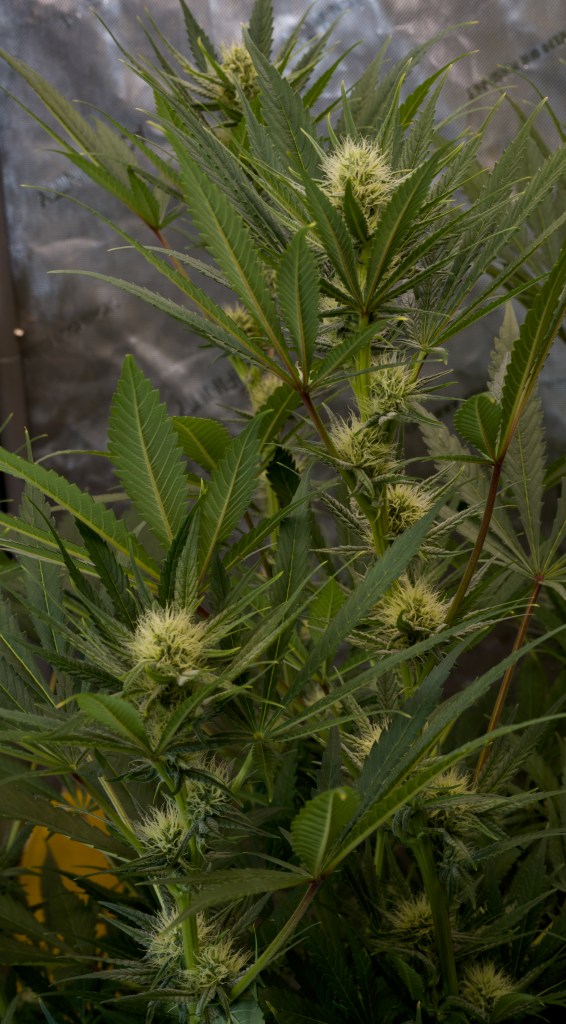
This is the same branch, two days later @ day 23. Note resin frost onset.
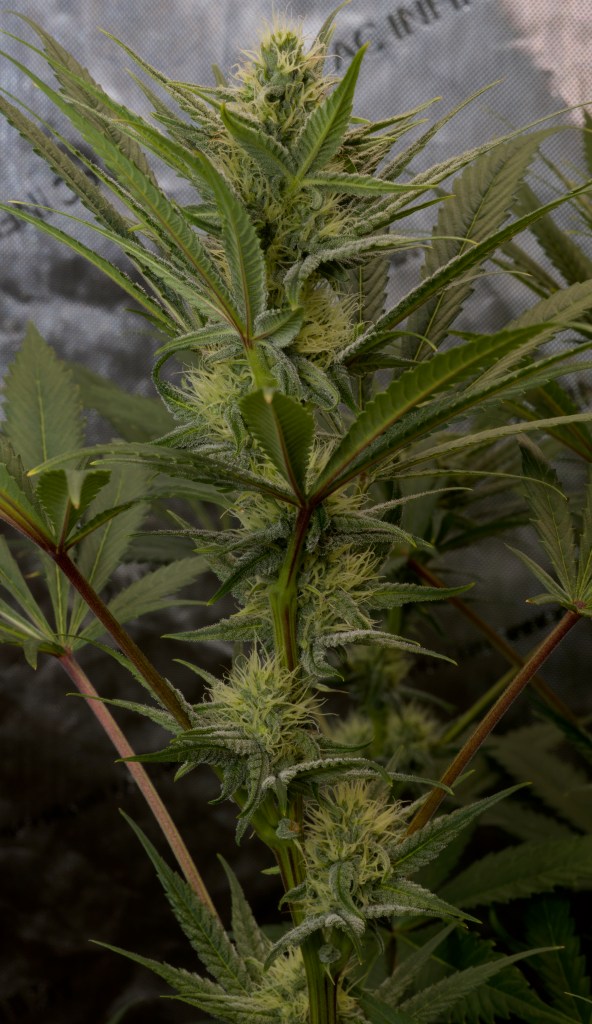
This is the same branch four days later, @ day 27. Note incredibly fast node fill-in and resin gland development…
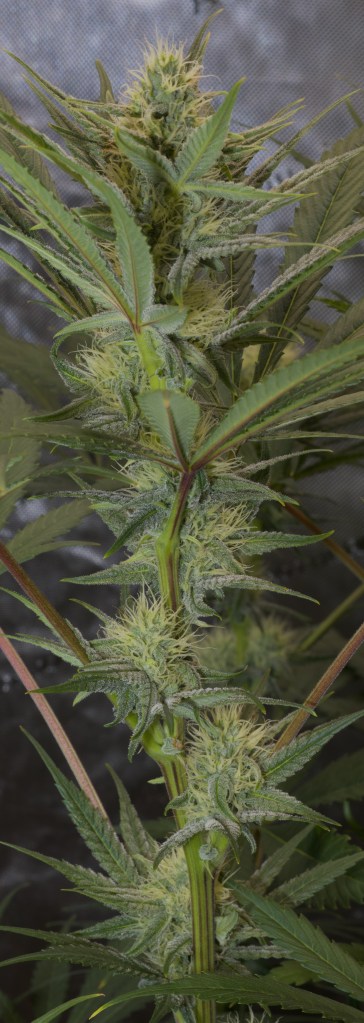
One final note: if you love Afghani cannabis and old-school hashish, you’ll love two books:
- Hashish, second edition, by Robert Connell Clarke
- The Great Books of Hashish, Volume 1, by Laurence Cherniak. Good luck getting the gorgeous Cherniak book, loaded with stunning photos of heritage hashish. The book has become a collector’s item.
 Growing Marijuana Perfectly!