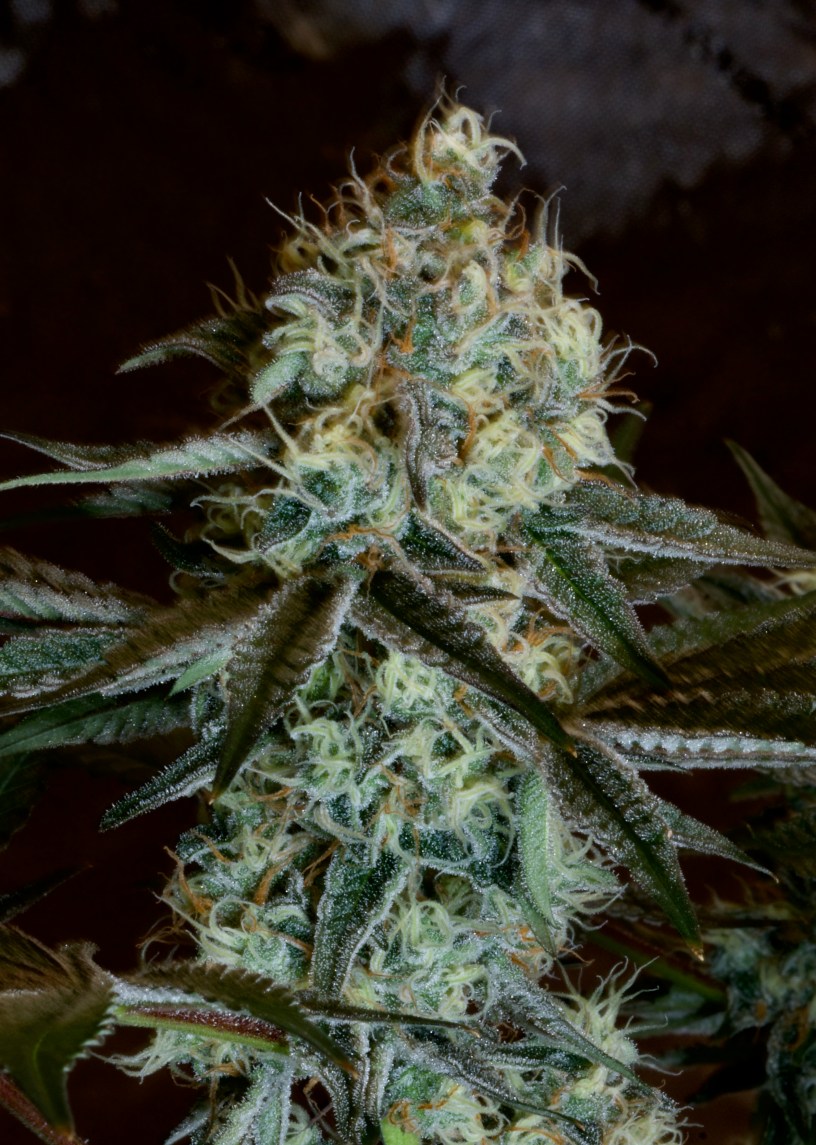
We just completed an indoor test season that included Dutch Passion’s feminized photoperiod strain Tropical Tangie.
Tangie is a strain type easily identified by its trademark scent, which is like tangerine rind. The scent has similarity to Mimosa and Orange cannabis strains, but is unique on its own.
Dutch Passion’s Tropical Tangie is a cross of two pure Tangie strains, and well delivers on Tangie scent, with just the slightest hint of fuel and non-tangerine citrus fruits.
Dutch Passion describes TT as Sativa dominant, so we were surprised when it was the shortest cultivar of several in the test garden. Hoping to get more height and structure, we gave Tropical Tangie more time in grow phase than usual, hoping it would build more biomass. But it didn’t even double its height during bloom phase stretch. None of the TT plants were taller than three feet at harvest!
Tropical Tangie was the fastest to pre-flower and generate early buds and resin glands of any of the strains in the test room, including some that were Indica dominant. This is the opposite of what you see from most Sativas.
Another interesting trait is that the buds, although very fast developing and exceptionally resinous, were chunky and thick, rather than thin with long internodes like most Sativa buds are.
One reason we grow several strains in the same test room is to see which if any strains are repellant to pests and pathogens, and which ones attract them. When you have five strains in a room and only one of them develops a spider mite infestation and powdery mildew, as Tropical Tangie did, and the other ones do not, we call that strain a “magnet” for whatever pests or pathogens infested the strain.
Such “magnetism” in healthy cannabis plants comes from the terp profile, bud structure, and other traits being attractive to the detected pests or pathogens, rather than repellant. The other four strains in the room, even though they grew mere inches from the Tropical Tangie plants, did not get powdery mildew or spider mites.
Fortunately, powdery mildew and spider mites are relatively easy to defeat if you detect them early enough (in grow phase) and use effective interventions including:
- Changing grow room temperature and humidity to make environment hostile to targets pests and pathogens.
- Ensure that all vectors that could transfer pests and pathogens into your grow room are eliminated.
- For spider mites, the most effective intervention we’ve used is Azamax, which has two negatives. One is that it’s sold by an anti-environment, poison-dispensing, monopolistic corporate criminal, Scott’s Miracle Gro, through a front company. The other negative is extreme price gouging. A four ounce bottle of Azamax that cost $25 in early 2024 is now $85, if you can even find it. A grow store told us a new product called HygroPunch was as good or better than Azamax, but when we contacted the manufacturer and asked for third-party test data and samples so we could be sure the product works well, they were totally uncooperative. In almost all cases, when a manufacturer refuses to provide science to back their product claims, it’s because they have no proof their product works and are afraid to have skeptical cannabis journalists test it.
- Ultraviolet-B radiation applied to leaves just before lights out at least partially kills powdery mildew, gray mold, and other pathogens.
- Powdery mildew is best eliminated by changing environmental conditions away from conditions that favor it. PM likes stagnant air, high relative humidity at night and low relative humidity during the day, with temperatures between 70-80°F. You also eliminate powdery mildew by rubbing it off gently, or by using a very diluted foliar spray of potassium silicate, or baking soda, in water with a surfactant added.
Dutch Passion says TT has a bloom phase of 8-9 weeks, which is very short for a Sativa. We noticed strong tangerine scent two weeks into bloom phase and cloudy resin glands starting four weeks into bloom phase. In all but a few marijuana strains, cloudy resin glands are a sign of bud ripeness.
By day 54, the majority of TT resin glands were cloudy, which indicates harvest time had come. Yield per plant was small, averaging about 55 grams of tight, dense buds that did not look at all like Sativa buds.
Based on what other growers said about the strain, and its short stature and fast flowering time, we thought the high would be Indica dominant.
Fortunately (because we like stimulating rather than couchlock cannabis), the Tropical Tangie high is a sparklingly lovely Sativa, without paranoia or racing thoughts, very energetic, uplifting, clarifying, manageable. Great for dancing, festivals, athletics, music-making.
Not only that, TT was the strongest strain of the five we grew, even though DP’s website THC meter inaccurately shows this strain as being less potent than other DP strains in the grow room with it.
DP says this strain averages about 17% THC, but the buds we got from it are likely 23% THC or higher!
Please note that this strain report comes from only one test season. Usually, we won’t report favorably on strains until we’ve tested them for at least three seasons. This is because although we run grow rooms with ideal PPFD, VPD, nutrients inputs and other factors, seed strains often have phenotype differences batch to batch. This means you might grow Tropical Tangie and your plants are larger, with higher yield.
For anyone growing cannabis to retail it, customers who love citrus strains and stimulating highs are going to pay big money for Tropical Tangie once they find out how fun and potent it is.
The taste and smell are rich and delicious. Using a whole-flower vaporizer below combustion at 394°F, you get a creamy orange taste and lovely aftertastes. Our team agrees that this is the most tasty “orange” marijuana strain we’ve sampled out of dozens.
One of our team members had Tropical Tangie buds in a stainless steel container at a nightclub, and people kept saying things like: “It smells like oranges in here, WTF.”
As we’ve stated before, there are less than half a dozen marijuana seeds companies operating ethically, sourcing new genetics, using professional breeding to create reliably fire strains that grow well and produce wonderful effects and scintillating terp profiles. Dutch Passion is one of the few.
Another top performer from Dutch Passion, one of the top five strains we’ve tested out of hundreds, is Sugar Bomb Punch.
Important Update: On our second test of this strain, from a different batch of seeds, the plants were totally different than the first test–they lacked citrus scent and the high was way more like Kush than a tropical Sativa. Before you order seeds of this strain, contact Dutch Passion and ask if the seeds currently for sale are the original pure Sativa with citrus scent that we got the first time we grew the strain and as described in the article.
 Growing Marijuana Perfectly!