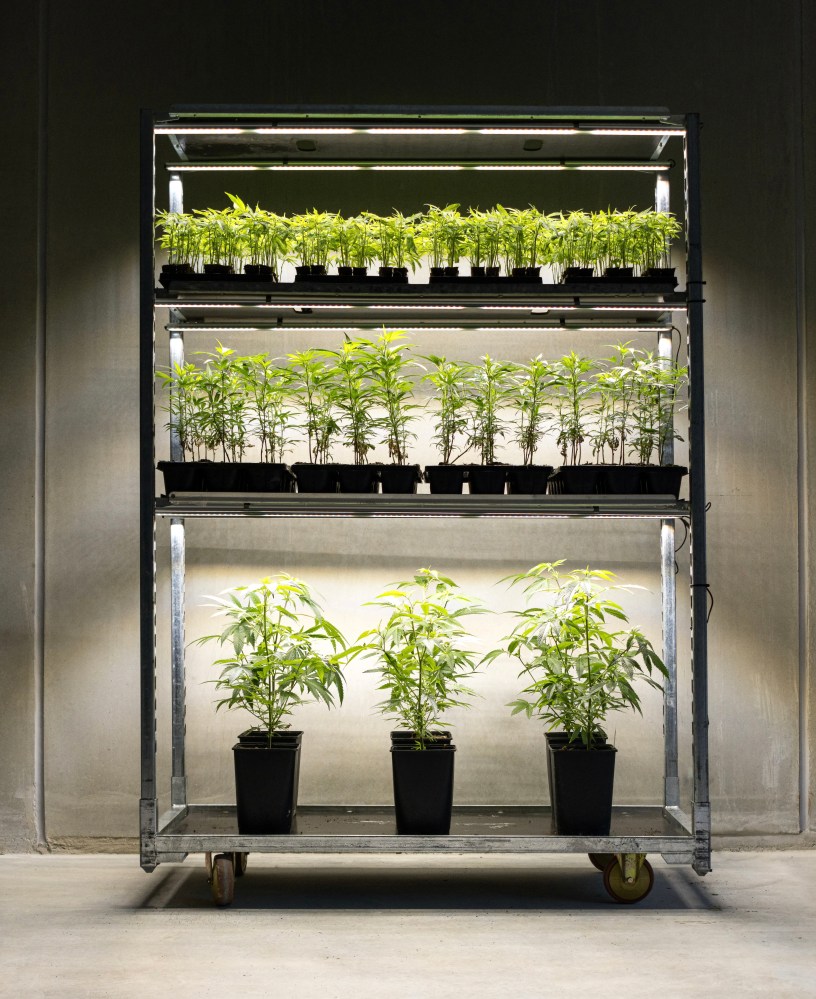
Germinating seedlings (or rooting clones) and ensuring their most vigorous development and structure is harder than you think, and some of the biggest factors in seedling growth are the amount of light, and the light spectrum, that you give them.
You measure seedling quality, health, and structure by the following metrics:
- Thickness, sturdiness, height of main stalk.
- How soon did the first true leaves (serrated leaves) develop after the cotyledons first showed?
- How soon did subsequent true leaf sets appear?
- How much spacing between leaf set nodes?
- Is the plant top-heavy, falling over, has a spindly stalk?
- Are leaves uniformly healthy and lime green, not curling or showing signs of stress?
- How fast do roots grow out of the bottom of the germination pots or cubes?
- How many inches per day is the plant growing after roots are established (usually within two weeks of germination)?
Several factors influence how healthy and vigorous your seedlings or cuttings are. This article focuses on the lighting factor, but it’s good to monitor all of them:
- Environmental conditions: vapor pressure deficit, temperature, humidity, air flow, crowding, zero pests or pathogens.
- Overwatering or underwatering. Both can kill seedlings or at least significantly slow their growth rate.
- Inferior nutrients, root zone media, overfeeding or underfeeding, wrong pH, polluted (not reverse osmosis) water, insufficient root zone size.
- Light spectrum, light intensity, number of hours of light per 24 hour day.
When I’ve germinated seeds outdoors in late spring and early summer, I get my most robust, sturdy seedlings. Getting that level of health and fitness using indoor grow lights is a challenge.
Lighting seedlings, clones, and general grow phase indoors during decades of growing using metal halide, fluorescent, and LED grow lights left us frustrated and puzzled by wildly different performance of young plants under different lights.
Seedlings develop sturdier and grow faster under spring and summer sunlight than under ANY grow light we’ve tested. But seedlings germinated under autumn or winter sunlight sometimes displayed spindly stalks and other problems commonly seen under most types, models, and brands of grow lights.
The scientific reality is that light intensity and light spectrum should be deliberately optimized for seedlings and cuttings because their spectrum and intensity needs are somewhat different from bloom phase plants.
Seedlings are programmed by evolutionary biology to do best under specific light spectrums and intensities, but most grow lights don’t deliver either or both.
PPFD (photosynthetic photon flux density) is the precision way to measure grow light intensity. When you have a grow light with the wrong spectrum for seedlings, you may have to deliver 400 or more PPFD to just-germinated seedlings or they’ll stretch and fall over.
Unfortunately, 400 or more PPFD is often too much for seedlings (depending on the strain), resulting in stunted plants that never recover.
Many grow light brands we tested had such an inappropriate spectrum that it didn’t matter how much or how little PPFD you gave them, they grew too tall, too short, were stunted, or showed signs of stress.
When bad things happen to seedlings or cuttings early in life, it creates structural, growth rate, and yield deficits you can’t fix later.
The good news is that the world’s only science-based LED grow light company has conducted years of research to find the ideal spectrum and PPFD for seedlings and grow phase plants all the way through 39 days after germination.
The company is SANlight, based in Austria. You can read about our comparison tests of SANlight versus Gavita, Fluence, Spider Farmer, HTG, Black Dog, and other grow light companies.
Out of the dozens of companies manufacturing and selling grow lights, SANlight is the only one with enough confidence in their gear to publicly post technically-detailed spec garden photos and data to absolutely PROVE their LED grow lights outperform all other LED grow light brands as well as dinosaur-era grow lights like metal halide and high pressure sodium.
We recently heard from SANlight about their new Flex II LED grow lights that are made specifically for seedlings and cuttings.
Flex II lights are engineered for maximum energy efficiency and increased marijuana growing rewards, and come in three sizes, each with different power consumption. They’re great as a stand-alone light or for multi-layered growing (as seen in the photo for this article).
The Flex spectrum was developed during years of testing in commercial cannabis seed germination and clone facilities, and has more blue spectrum than red spectrum.
Although SANlight testing recommends variable light intensities depending on lighting configuration and cannabis genetics, PPFD of 200-280 seemed to produce the fastest growth, most internodes, shortest internode distance, least stretching, fastest and best root development.
SANlight made sure the Flex is waterproof and super-engineered for tens of thousands of hours of worry-free use.
You may be wondering what grow light to use after 39 days, when grow phase is over. SANlight’s EVO series, which was recently updated to make it even better than it already was, are what you use for late grow and bloom phase.
The main benefits in their upgraded EVO series are more energy efficiency, more PPFD, an improved spectrum for boosting floral weight and potency, and increased longevity. These gains come from SANlight’s constant cannabis garden research and their use of the latest, best LED chips from Seoul Semiconductors, the world’s leader in LED chip design.
The superiority of SANlight LED grow lights’ light spectrum, design, warranty, longevity, and performance already make them the most productive, reliable choice for indoor marijuana growers.
But SANlight goes beyond technical and hardware superiority by being 100% honest, ethical, and helpful.
When we get a new grow room or grow tents, for example, we send SANlight measurements and other specs—they send back a 3-D model showing perfect placement, use, and PPFD for our grow space.
This level of personalized service has never been offered to us by any other grow light company. In fact, when we ask other LED grow light manufacturers for specs, light spectrum charts, and other information, we never get any response, or any useful response.
This is especially true for corporate greed companies like Fluence and Gavita.
Want to see how superior SANlight is? Check out this article, which links to a SANlight template that gives you all the information you need on lighting, feeding, grow room environment, along with detailed data charts and successive photos, to prove their lights power a big-buds crop cycle…all publicly documented for you to examine.
If you duplicate their set-up with quality marijuana strains, you are guaranteed to get your best marijuana growing results ever!
SANlight now has USA distribution, so get in touch with them today. No matter how satisfied you believe you are with your current grow lights, when you replace them with SANlight, you get faster growth, higher yields, more cannabinoids and terpenoids, at a lower energy cost.
 Growing Marijuana Perfectly!