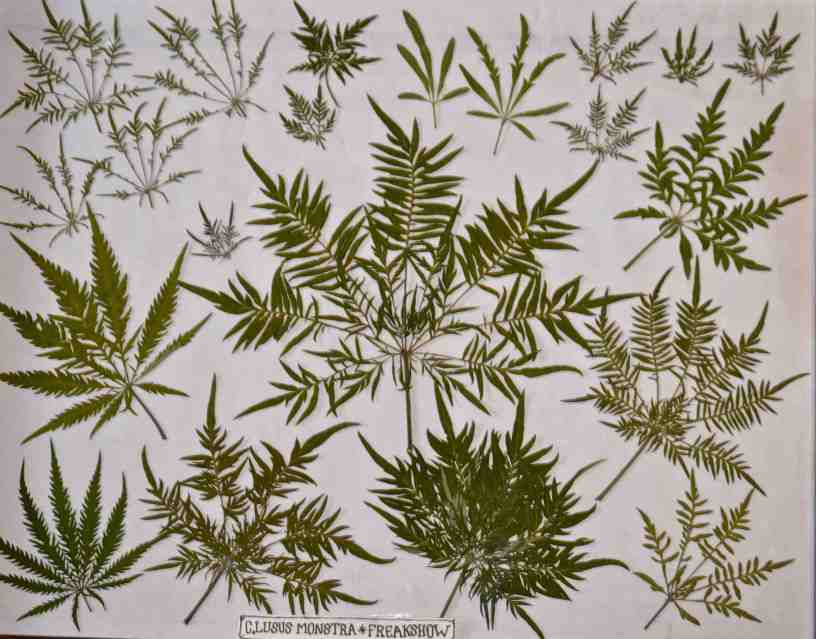
If you were standing next to a plant that has mutant leaves like the ones in the photo above, would you know it was marijuana? Maybe not, but those leaves really are from a strain of potent marijuana.
Most of us would love to have a magical invisibility cloaking mechanism that makes marijuana plants “disappear” from view, especially when we’re growing outdoors.
Now, thanks to a California cannabis breeder and Humboldt Seed Company, you have something like that.
I’m talking about “Freakshow,” a totally new cannabis strain never seen before. Like the name says, it’s a freak, a mutation, an alien genetic line. Take a look at the photo above this article and the one below this paragraph. Those are Freakshow leaves and buds.
Do those look like marijuana leaves to you? Well, they don’t look like marijuana leaves to police or thieves either, and that’s just the beginning of how Freakshow is different from any other strain of cannabis you’ll grow.
So how did the Freakshow marijuana strain come into existence? The story begins in 1971 when a rugged, creative kid named Jordan who had barely turned 13 started planting cannabis seeds he and his friends got from imported Colombian, Mexican, Thai, Hawaiian, Afghani and other heritage and landrace marijuana strains.
Jordan recalls that even back then, many serious cannabis connoisseurs were mixing and matching genetics to create hybrid marijuana strains. He notes a lot of growers were intent on inserting Afghani genetics into Sativa strains, so they could reduce bloom phase duration and plant height while increasing yield and preserving the soaring, stimulating Sativa high.
During his late teens, Jordan was living in the hippie-surfer-cannabis breeder paradise of California’s central coast near Santa Cruz. That’s also where the famous Haze Brothers were, developing the first Haze strains, and Jordan quickly learned a lot about breeding fine cannabis.
By the time Jordan was 22, he’d moved into the foothills of California’s majestic Sierra Nevada mountain range.
Living at 4,000 feet elevation, he was dismayed to discover that Sativa strains that had grown well at sea level on California’s coast were struggling to survive in the cold, oxygen-deprived air of 4,000 feet elevation.
So even though Jordan much preferred landrace Sativa to the many strains of Afghani-Indica-Sativa hybrids that were flooding the market, he began inserting genetics from his favorite Hawaiian Indica into pure Sativas he’d been collecting and breeding, trying to alter his non-hybridized Sativa strains just enough so they’d have shorter bloom phases and could handle all kinds of growing conditions, including indoors, and in cold weather, rain, snow and high elevation.
In 1996, after decades of breeding marijuana, Jordan was glad to see Californians pass Proposition 215, Dennis Peron’s landmark medical marijuana law, the first voter-approved state law that legalized personal marijuana growing and transfer.
Jordan was excited when Prop. 215 legalization created an immediate burst of craft marijuana entrepreneurship and grower/breeder networking. His cannabis genetics program expanded as he grew, tested and examined nearly a thousand strains, looking only for top phenotypes, and germinated tens of thousands of seeds. He recalls ruthlessly culling vast herds of phenotypes, only keeping the very best individual plants.
One day Jordan noticed bizarre morphologies in a few cannabis plants, and this formed the genesis of his mutant cannabis breeding programs. The most visible of these mutations are leaves that don’t look like marijuana leaves. He first noticed a webbed-leaf female plant he named Webster.
The plant had favorable characteristics along with its mutant leaves. Jordan germinated hundreds more plants from that same batch of seeds, but couldn’t find a male Webster. So he bred his female Webster with a premium male that had pinnate leaves. Pinnate leaves look like feathers.
In the following generation, approximately 25% of the plants showed webbed leaves. After a lengthy six-generation breeding program, Jordan had locked in the desired leaf mutation trait 100%.
He then selected a phenotype that was purple from top to bottom and created a Purple Webster that smelled like gingerbread.
Jordan continued decades of breeding, in part to increase the presence of ultra-thin and narrow Sativa leaves and high leaflet counts, making crosses that included mutated leaves he calls “sawtooth” leaves.
He says most leaf mutations were showing up only on male plants, and Jordan worried that mutant leaf traits were sex-dependent.
However, he eventually found females with these mutations.
His breeding projects focused on preserving favorable mutations, as well as creating plants with very high THC and terpenoid content, and other desirable characteristics of pure Sativas. He describes Freakshow as being so far off of “normal” morphological development that it deserves its own species listing.
Jordan says Freakshow is an unusually resilient strain that handles harsh conditions, is moderately resistant to pests and mildew, and is easy to grow, so it’s a good choice for beginner growers. “Its dominant smell is pine and limonene, totally delicious,” he says.
Even though it’s Sativa-dominant, it only needs a 7-8 week bloom phase indoors to finish, and often finishes before the end of September outdoors.
One big problem with this strain is that it lacks THC, and has a strange cannabinoid profile, so the high is not pleasant or potent. Although this strain might be fun to grow just because it’s such a mutant, if you’re looking for fire psychoactive effects, this isn’t it going to do it.
Another problem is hermie clusters, especially if you try to grow it indoors. If someone bred a truly high-potency strain with a dazzling high that also had leaves that don’t look like marijuana leaves and did not have hermie traits, THAT would be useful!
If you’re so worried about outdoor growing security that you’re willing to grow a low-potency mutant strain, try growing high-potency feminized photoperiod indoors. You’ll get lots better results!

 Growing Marijuana Perfectly!